
Case study · Sod supply & online store
A & N Sod Supply
A & N Sod Supply is "the Get it Done Company since 1999": a Marietta, Georgia sod supplier that harvests every pallet to order and delivers it to the street. WebsiteTek redesigned its online store for every device, moved it to our own server, and locked it down.
The A & N Sod Supply website on a computer and a phone
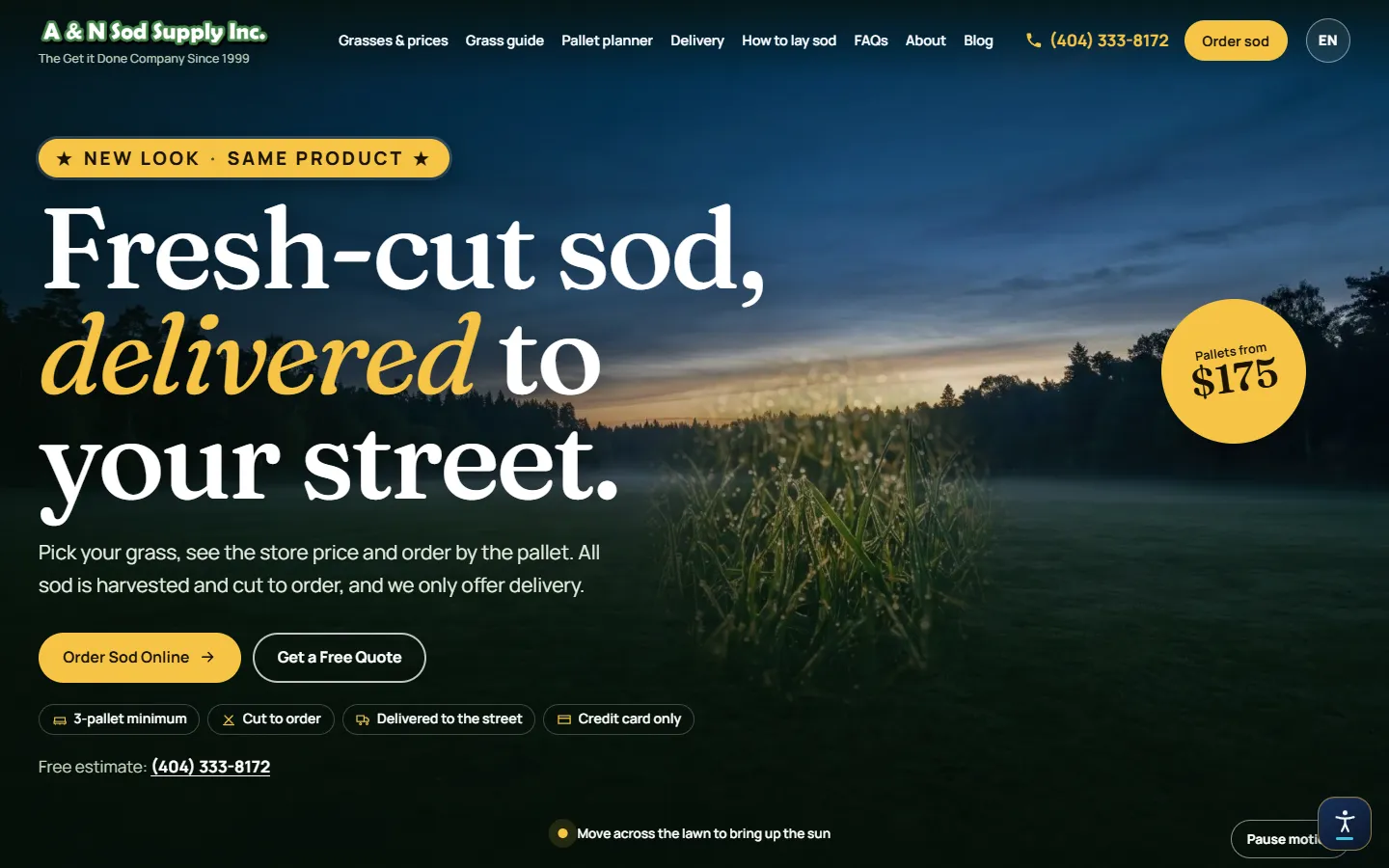
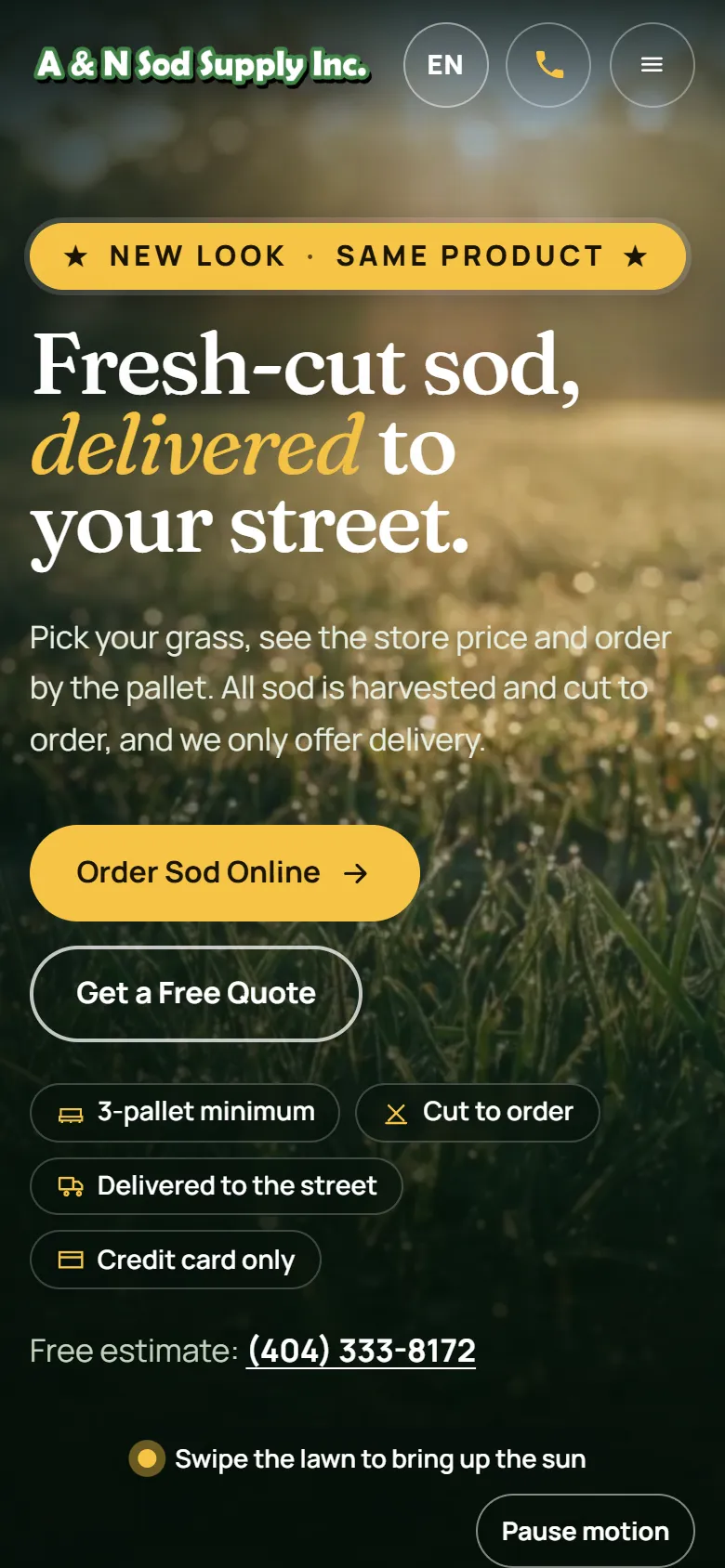
- IndustrySod supply & online store
- LocationMarietta, Georgia
- Pages123
- LanguagesEnglish, Spanish and French
- Accessibility menuBuilt in
The redesign
A store from another era, rebuilt for every device.
The old store worked, and customers had trusted it for years. But it looked and behaved like a website from another era: a narrow layout built for a desktop screen, small text on phones, a Google translate drop-down in the corner, and a quote form whose security check had stopped working. And many customers now shop on a phone.
We redesigned it from the phone up. The new store puts the grass, the price and the Order button first, at a size you can read and tap with a thumb. The same pages stretch out on tablets and computers, load less, and stay steady while they load. Languages are built in, not machine-translated on the fly, and the checkout speaks the customer's language too.
The business never stopped selling. The switch to the new store was planned, rehearsed and tested before a single visitor saw it.
What we built
Designed and hand-built by WebsiteTek.
- A new phone-first design called "Cut at Dawn", with a "New look · Same product" badge so returning customers know they are in the right place
- A home page that opens with "Fresh-cut sod, delivered to your street.", prices from the store, and a lawn you can touch or swipe to bring up the sun, with a button to pause the motion
- The sod shelf: 12 grasses across Bermuda, Zoysia, Centipede, Fescue and St. Augustine, each with its pallet price and an Order button
- A pallet planner, a grass guide, delivery details, how to lay sod, and answers to common questions
- An English, Español and Français button on every page, including the cart and checkout
- A free-quote form that works on a phone, saves every request and emails the office
- 28 city pages rewritten with a local section and four questions and answers each, plus fixed Google titles and descriptions on every page
- A built-in accessibility menu, and Facebook and Instagram in the footer
Before and after
From the old site to the new one.
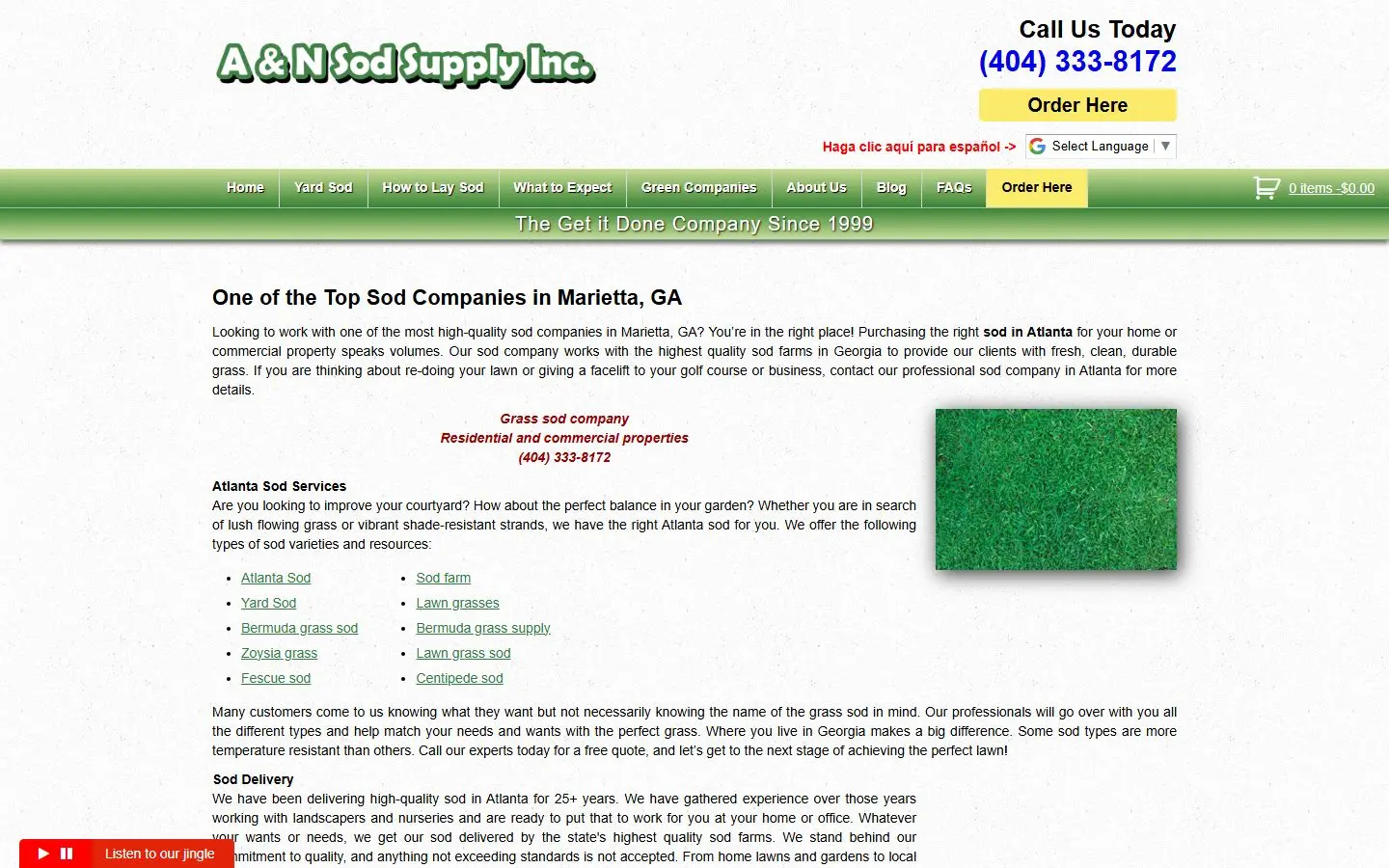
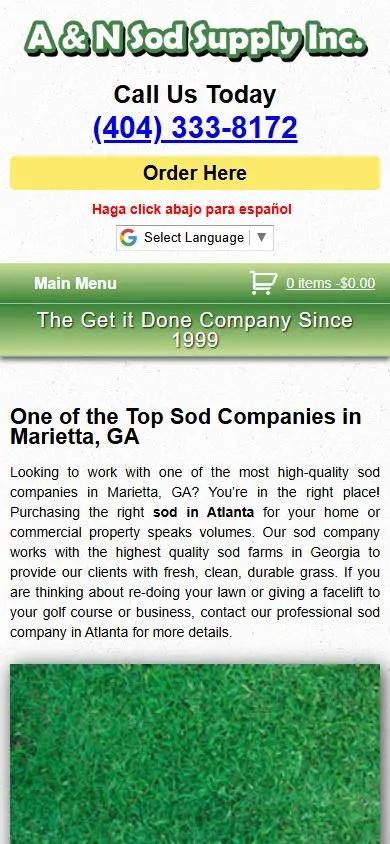
Measured, not guessed
What changed, in numbers.
| What we measured | Before | After |
|---|---|---|
| Mozilla security grade | F (5 of 100) | B (75 of 100), A in testing |
| Home page on a phone | 3,414 KB in 128 files | 1,242 KB in 51 files |
| Languages | A Google translate drop-down | English, Spanish and French, built in |
| Free quote form | Security check broken | Works on a phone, every request saved and emailed |
| City pages (28) | About 460 words, nearly identical | 850 to 916 words, each with a local section and 4 answers |
| Google descriptions | 18 pages missing one, 60 too long | Every page has one that fits |
Security grades from the Mozilla HTTP Observatory, scanned November 15 (before) and November 16, 2026 (after). Page sizes measured with Google Lighthouse on a phone setting, November 15 (old store) and November 16, 2026 (live store). Everything else was counted from the store's pages.
Search (SEO)
Easy to find on Google, and in AI answers.
A beautiful store does not sell much if people cannot find it. Before we changed a word, we checked every one of the store's 123 pages the way Google reads them. The design looked dated, but the bigger problem was out of sight: the store was telling Google and AI assistants very little about itself.
What we found
- 18 pages had no description for Google at all, so Google wrote its own from whatever text it found
- 60 descriptions and 9 page titles were too long, so Google cut them off mid-sentence in its results
- 28 city pages, one for each grass in each city, of about 460 words each with nearly identical text, which Google tends to treat as one page and show only one, or none
- Old archive pages with nothing useful on them were open to Google, competing with the real pages
- Nothing to help AI assistants such as ChatGPT or Google's AI answers describe the business
- A heavy page on phones, with small text, at a time when Google ranks websites mainly by how their phone version works
What we fixed
- A clear, complete title and description on every page, written for a person deciding what to click, such as "Bermuda sod delivered by the pallet in Kennesaw, GA. Cut to order, 3-pallet minimum, delivered to your street."
- Every city page rewritten to 850 to 916 words: the original text kept, plus a new section written for that city and four answers to the questions buyers there ask
- Structured data on the city pages: behind-the-scenes labels that tell Google this is a local business, what it sells, where it delivers, and the questions it answers
- The empty archive pages hidden from Google, and a clean map of the site that lists every real page, product and article
- A plain summary of the business published for AI assistants, and a check that Google, Bing and AI crawlers can all reach the store
- A phone-first design, roughly a third of the old page weight, with text sized to read without zooming
Why it makes a difference to rankings
More clicks from the same spot
The title and description are the store's shop window on Google. A clear one that names the grass, the city and the offer gets more people to click, even before the ranking moves.
A real chance for every city
When 28 pages say almost the same thing, Google picks one and ignores the rest. Pages that are each genuinely different and useful give Google a reason to show the Kennesaw page to someone searching in Kennesaw, and the Roswell page in Roswell.
Google understands the business
Structured data spells out what the business is, what it sells and where, in a format search engines read directly. It removes the guesswork about whether this is a sod supplier that delivers to your street.
Ready for AI search
More and more people ask an AI assistant "where can I buy sod near Marietta?" instead of searching. A clear summary and open doors for AI crawlers help those assistants find the store and describe it correctly.
Built for the phone, which is what Google ranks
Google judges a website mainly by its phone version. A lighter, faster, easy-to-read phone page is one of the signals it uses, and it keeps visitors on the page instead of sending them back to the results.
Strength kept in one place
Hiding empty pages and keeping a clean site map means Google spends its time on the pages that sell, not on leftovers.
An honest word about rankings. No honest company can promise a number-one spot on Google. Search results take weeks to a few months to reflect changes like these, and competitors keep working too. What we can promise is that the store now gives Google and AI assistants everything they look for, which is the foundation that better rankings are built on.
Next, more content for the city pages, the product groups and new blog articles, to keep giving people and search engines new reasons to visit.
See our SEO serviceSecurity
From an F to a B, and on to an A.
An online store that takes card payments is a target, whether it is famous or not. Robots test every store they can find, all day. Before the move, Mozilla's public scanner gave this store an F, its lowest grade. We applied the same protection we sell in our website security service.
- FBefore5 of 100
- BToday75 of 100
- ANextAfter a one-week test
What we did
- Cloudflare in front of the store, filtering out attacks before they ever reach it
- The browser safety rules Mozilla checks for, switched on from the first day of the new store: grade F to B
- Sign-ins tightened and access reviewed, so only the right people can get in
- All software brought up to date, and anything the store did not need removed
- Email protected so it is much harder for anyone to fake mail from the business
- Automatic backups every night, kept safely away from the store
The road to an A
The last step to an A is one more layer of browser protection. On an online store we never switch protection on blindly: we test it for a week first, so nothing a customer needs is ever blocked. Then it goes live and the grade goes up.
See our website security serviceMozilla HTTP Observatory, November 15, 2026 (old store: F, 5 of 100) and November 16, 2026 (live store: B, 75 of 100).
Under the hood
The work you do not see, behind every page.
A shop is far more than a brochure website. Behind every page there is a catalog, a cart, a payment form and customer emails, and all of it has to keep working while the store changes around it.
WordPress and WooCommerce
The store runs on WordPress with WooCommerce, the most widely used online store software. We built a custom theme from scratch, so the new design changes the look without disturbing how the store sells.
A modern PHP engine
PHP is the language WordPress runs on. The store now runs on a current, supported version, so it keeps getting security fixes and runs on today's technology.
Our own server
We moved the store from shared hosting to WebsiteTek's own managed server, behind Cloudflare. We rehearsed the switch and checked everything before sending visitors to it.
Checkout in three languages
Translating a store is harder than translating a page: the menu, the cart and the checkout all have to match. We wrote our own wording for the menu and the checkout summary instead of trusting a translation tool.
Tested after every change
After every change we ran a test purchase through the cart and checkout and checked the totals to the cent. Along the way we found and fixed a slip in WooCommerce's own code that made product pages do extra work.
Email that moved with it
The business's email moved along with the website, so messages still arrive in the same inboxes and the office sends from its own business address.
Google PageSpeed Insights
Tested by Google's tool, not by us.
PageSpeed Insights is Google's free test for speed, accessibility, good practices, and search basics, run on Google's own computers. It tested the home page on November 16, 2026. Scores move a little from test to test.
On a phone
- 95Performance
- 100Accessibility
- 100Best practices
- 100SEO
On a computer
- 100Performance
- 97Accessibility
- 100Best practices
- 100SEO
Run the test yourself on PageSpeed Insights (opens in a new tab)
More case studies
See what else we have built.
Your business next
Want a website like this one?
Tell us about your business and we will reply within one business day with a recommendation and a fixed quote.







