Web design for mobile knife sharpeners

Websites for sharpeners on a regular route.

A mobile sharpener lives by the route: restaurants on Tuesday, farmers markets on Saturday, a street of home cooks in between. The website has to show which blades you take, when you are nearby, and how to get on the list.

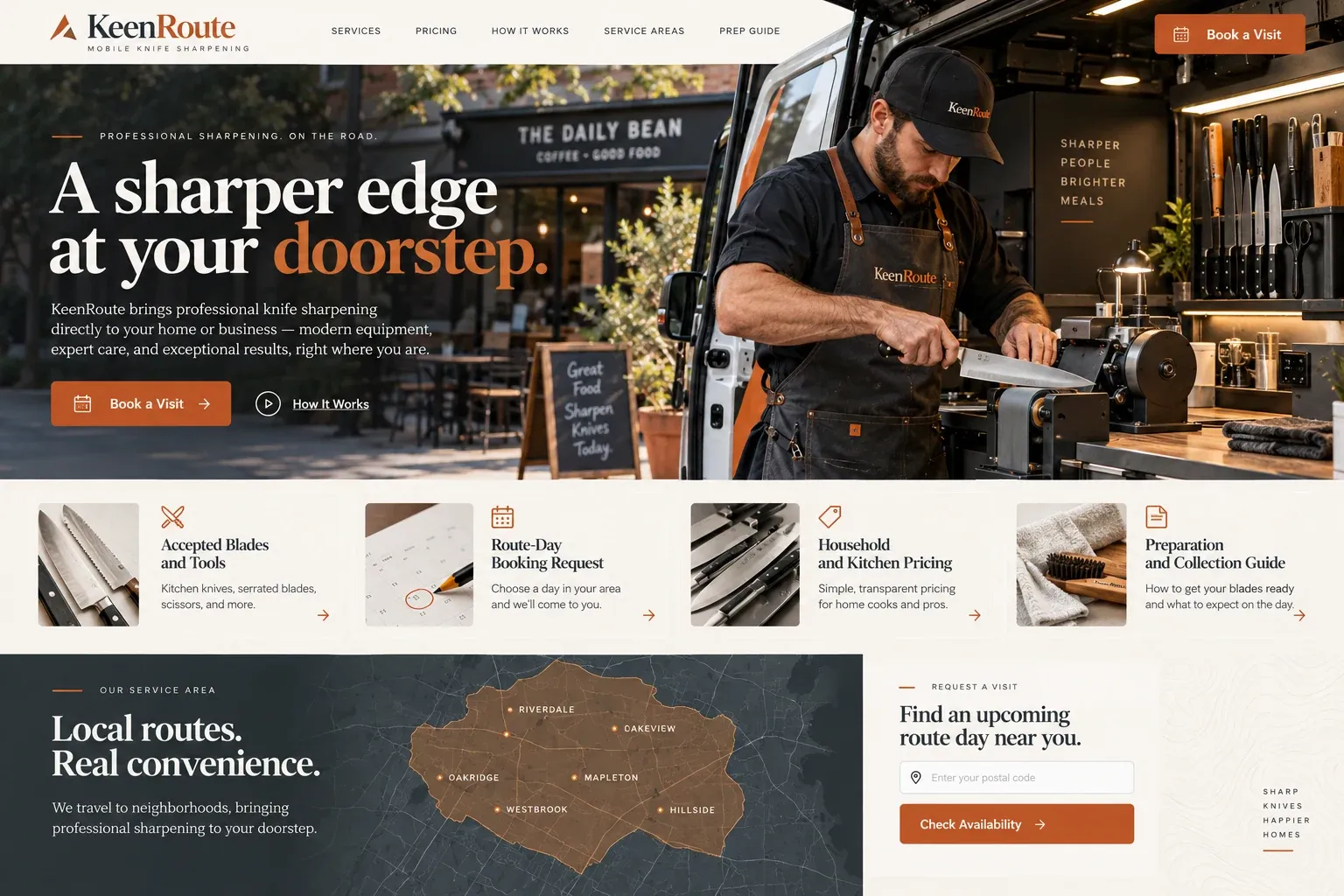
Fictional mobile knife sharpening services website design showing an at-home service
A design concept for a fictional brand. Your site is designed from scratch around yours.

Your customer's story

Dull knives before the lunch rush

The kitchen at a small Cuban café in Little Havana opens for breakfast at seven, and by ten the prep cook is fighting the onions. Every knife on the magnetic strip is dull, and the one good chef's knife belongs to the owner, who guards it. Sending the set out for a week is not an option. During a quiet hour, the manager searches "knife sharpening service that comes to you".

Most results are shops that want the knives dropped off, or listings with no hours at all. One sharpener's site has a route calendar with Little Havana on Wednesday mornings, a list of what it takes, from chef's knives and bread knives to kitchen shears, and a note that chipped tips are assessed one by one. It also offers a loaner set so the line keeps cutting while the knives are in the van.

The manager fills in the route-day request: the café's name, the address, roughly how many knives, and the best hour to stop by. She ticks the box for the loaner set. A sharpening website wins regulars like this by doing what the van does: turning up on a predictable day, with clear answers about which blades it takes and which need a closer look.

Why it matters

Why mobile knife sharpeners need a website.

Knife sharpening is a repeat trade built on routes and habits. Restaurants want a dependable day each week or month, home cooks want to know when you will be on their side of town, and markets and hardware stores want to tell customers when you are set up outside. A social media post gets buried by the next one. A website keeps the route, the blade list, and the request form in one place that people can return to.

We build sharpening sites around your schedule. A route calendar or simple table shows which areas you visit on which days. A blade page lists what you sharpen, what you repair, and what you turn away. Separate pages speak to commercial kitchens, with standing visits and any exchange service, and to households, with drop points and minimum orders. Requests arrive by email, or through the booking tool you already use.

What your customers search for

  • knife sharpening near me
  • mobile knife sharpening Miami
  • restaurant knife sharpening service
  • knife sharpening farmers market
  • japanese knife sharpening
  • scissors sharpening near me

Your customers

What cooks and kitchens ask before booking a sharpener

  • Will you sharpen this blade?

    A clear list of what you take: kitchen knives, serrated knives, Japanese single-bevel blades if you do them, scissors, garden tools, and what needs a quote first.

  • When are you near me?

    A route calendar by neighborhood and day, so a home cook in Kendall or a kitchen in Wynwood can plan around your next visit.

  • Do my knives leave the kitchen?

    An honest description of where the work happens, in your van, at a market table, or at the kitchen door, and how long a typical batch takes.

  • Can you fix a chipped tip?

    A repairs section that separates routine sharpening from chips, broken tips, and bent blades, which you assess one at a time before naming a price.

What we build

What a website for mobile knife sharpeners should include.

  • Blade and tool list

    Kitchen, serrated, outdoor, and specialty blades, plus scissors and garden tools, with notes on anything you decline.

  • Route day calendar

    Which neighborhoods, markets, and partner stores you visit on which days, easy to update when the route changes.

  • Route-day request form

    Address, rough knife count, preferred day, and any repairs, sent to your email so you can slot the stop in.

  • Restaurant service page

    Standing visits, knife exchange or loaner sets if you offer them, and invoicing details for kitchen managers and owners.

  • Household drop and collect

    How home cooks bundle knives for pickup or a market drop, how to wrap them safely, and when they come back.

  • Before and after close-ups

    Edge photos and paper-slice clips from your own work, which show the result better than any description can.

Planning guide

What should a mobile knife sharpening website tell customers?

A sharpening website is mostly practical. Customers want to know what you sharpen, when you will be nearby, how to hand over their knives, and what happens to anything damaged. Answer those clearly and the site does much of the scheduling for you. Here is how we lay out the pages, what to show, how requests work, and how locals find you.

Split home cooks from commercial kitchens

The two audiences want different things. A home cook wants to know the nearest stop, the minimum order, and how to wrap a bag of knives. A restaurant, butcher, or caterer wants a standing day, a quick turnaround, and perhaps loaner knives while theirs are out. Give each its own page, with a blade list page and a route page that both link to, plus an about page with your setup.

Show edges up close and the van

Close photos of a finished edge, a repaired tip, or a reground serrated knife show care better than words. Short clips of a blade slicing paper or a tomato work well on phones. Add a picture of your van or market table so customers recognize you. List the blades you decline, such as ceramic knives or antique swords if you do not take them, so nobody hands over something you will return untouched.

Make route days easy to book

Publish the route as a simple table by day and area, and update it when it changes. A request form should ask for the address, a rough count of knives and tools, the preferred route day, any repairs, and for businesses, the best time to come between services. If you already use a booking tool such as Square or Calendly, link to it instead and keep the form for repairs and businesses.

Explain the handover. Do customers bring knives out to the van, leave a wrapped bundle with a doorman, or meet you at a market stall? How long does a typical batch take, and do they wait or come back? Ask that knives be wrapped in a towel or sleeve and never loose in a bag. These small rules keep each stop short and everyone's fingers safe.

Turn each stop into a search result

People search "knife sharpening near me" and then a neighborhood or market name. A route page that names each area and stop gives search engines something specific, and a page for restaurants catches the commercial searches. On your Google Business Profile, show a service area instead of a public address if you work from the van, keep your name and phone consistent, and ask regular customers for reviews. Market organizers and partner stores may link to you as well.


In your market

Sharpening for South Florida kitchens

South Florida has a dense restaurant scene, from Cuban cafés and sushi bars to hotel kitchens on the beach, and plenty of home cooks who take their knives seriously. Humidity and salt air are hard on carbon steel, so rust spots come up often. After a storm, machetes and pruning saws come out of the shed needing an edge. Weekend markets give sharpeners a place to set up, though summer rain can cancel a stall. We write route pages around neighborhoods and markets, and can add a Spanish version.

Questions

Questions mobile knife sharpeners ask us.

How should a knife sharpener show the weekly route online?

As a plain table or calendar by day and neighborhood, with market stops and partner stores named. It gets its own page, linked from the home page and from every request button. When the route changes, you send us the new days and we update the page, so customers are not planning around an old schedule.

Can restaurants set up standing knife sharpening visits through the site?

Yes. A commercial page explains standing visits, any loaner or exchange set you run, and how you invoice. Its short form asks for the business name, a contact, the address, a rough knife count, and the quietest hour between services. Requests land in your email, and you confirm the day and how often you return.

Should our sharpening site list blades we do not take?

Yes. A clear no saves a wasted stop for both of you. List what you sharpen, what you repair after a look, and what you decline, such as ceramic blades or tools outside your equipment. Customers tend to trust a sharpener who is plain about limits, and you avoid handing back a bundle untouched.

What photos help sell a mobile knife sharpening service?

Close shots of finished edges and repaired tips, and short clips of a blade going through paper or a tomato, show your work quickly on a phone. Add your van or market table so people know what to look for on route day. Photos from your own bench do more than any stock picture of a knife.

Let's talk

Ready for a website built for mobile knife sharpeners?

Tell us about your business and we will come back with a clear recommendation and a fixed quote. No pressure, no jargon.

Trades we design for

See all 226 trades

226 trades

  • Plumbers website design concept
CallFree quote