Web design for basement waterproofing contractors

Website design for basement waterproofing contractors.

A wet basement is a problem people live with for years, then suddenly cannot. When they finally search, they want someone who will find where the water comes from before selling them a fix.

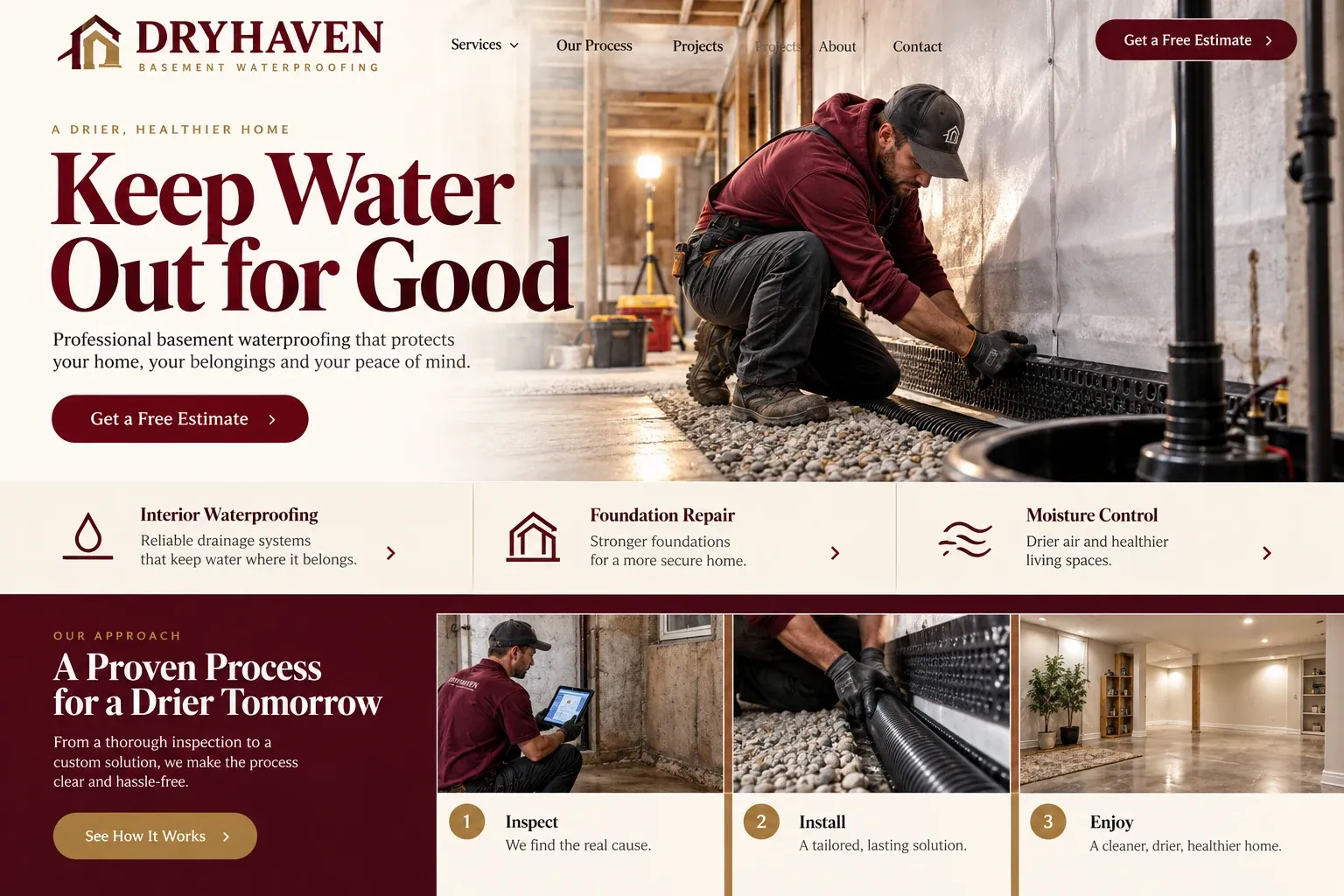
Fictional basement waterproofing contractors website homepage design concept
A design concept for a fictional brand. Your site is designed from scratch around yours.

Your customer's story

The finished basement smells like rain

Kevin and Dana finished their basement three years ago as a playroom and guest space. After a week of spring rain, there is a dark line along the bottom of the drywall on the north wall, the carpet near the corner feels cold and damp, and the room has a smell they cannot scrub out. They move the toy bins and the spare mattress upstairs and start looking for help.

Every company they find seems to sell one answer. One pushes an interior drain and sump pump before asking a single question. Another talks only about digging up the yard. A third has a page explaining how it inspects first: checking grading and downspouts outside, cracks and the wall-floor joint inside, and where the moisture readings are highest, then explaining which approaches fit what it finds.

That company's project pages read like short case notes: the problem the owners saw, what the inspection found, and the scope of work that followed, with photos. Dana fills in its form that night and attaches a picture of the stained wall. A waterproofing website earns trust by separating the assessment from the sale and showing that each house got its own answer.

Why it matters

Why basement waterproofing contractors need a website.

Homeowners with a wet basement are often skeptical before they ever call. They have heard about expensive systems that did not solve the problem, and they find plenty of conflicting advice online. They want to understand where water gets in, what the options are, and who will tell them honestly. A directory listing or a lead-generation site gives them a phone number and a sales call, not an explanation.

We build basement waterproofing websites that lead with the inspection. A process page explains what you check inside and outside and how you present findings. Service pages cover interior drainage, sump pumps, crack repair, exterior membranes, grading, and dehumidification in plain words. Each project story starts with what the owners noticed and ends with the work actually done, so visitors see that the answer changes from house to house.

What your customers search for

  • basement waterproofing near me
  • wet basement repair
  • sump pump installation
  • basement wall crack repair
  • interior drain tile system
  • musty smell in basement

Your customers

What homeowners ask before letting a waterproofer in

  • Where is the water actually coming from?

    An inspection page that explains how you trace moisture, from gutters and grading outside to cracks, joints, and humidity readings inside.

  • Do I need the whole system?

    Service pages that explain when smaller fixes, such as crack repair or downspout extensions, may be enough, and when larger drainage work is usually considered.

  • Will the musty smell go away?

    A page on humidity, dehumidifiers, and ventilation, with an honest note on when you refer mold concerns to a remediation specialist.

  • What happens to my finished basement?

    A page on how you protect finished spaces, what has to move, and how the room is left, with photos from finished-basement jobs.

What we build

What a website for basement waterproofing contractors should include.

  • Inspection-first service pages

    Each service page starts with how you diagnose the problem before describing the work, so visitors see the logic.

  • Problem and scope stories

    Project write-ups that name what the owners noticed, what you found, and what was done, with before and after photos.

  • Interior and exterior options

    Separate pages for interior drainage and sump pumps, exterior excavation and membranes, and crack injection, each in plain words.

  • Basement inquiry form

    Questions about where water appears, after what kind of weather, whether the space is finished, and photos of the problem area.

  • Sump pump service page

    Pump checks, battery backups, and replacements on their own page, a service owners often search for before the wet season.

  • Warranty and transfer details

    Written warranty terms and whether coverage passes to the next owner, which matters when a house goes on the market.

Planning guide

How can a basement waterproofer's website earn a skeptical homeowner's trust?

Basement waterproofing is a trade where the customer often expects a hard sell. A website that explains before it sells stands out. It should show how you find the source of water, describe the range of fixes honestly, and make it easy to request an inspection. Below is how we would plan the pages and what goes on each.

Separate the inspection from the sale

Give the assessment its own page and make it the first thing visitors reach from the home page. Explain what you check outside, such as gutters, downspouts, grading, and window wells, and what you check inside, such as cracks, the joint between wall and floor, and humidity. Say how findings are presented, in writing or in person, and that options are discussed before any work is agreed. If you bring in a structural engineer for serious cracks, say that too.

Write service pages that explain, not push

Interior drainage, sump pumps, crack injection, exterior excavation and membranes, grading corrections, and dehumidifiers each deserve a page. For each, explain the problem it addresses, the signs that point toward it, and what a household should expect while the crew is there. Note where simpler fixes sometimes help, such as extending downspouts. Readers trust a contractor who mentions the simple option.

Project stories are the proof. Start each one with the symptom the family saw, then the cause you traced, then the scope of the repair, with photos along the way. Keep them factual and tied to that house. A handful of honest stories persuades more than any claim of a dry basement forever.

Ask about the water on the form

The inquiry form should collect what you would ask on a first call: where the water shows up, after what kind of weather, how long it has been happening, whether the basement is finished, and whether there is a sump pump already. Allow photo uploads and a preferred time to talk. Keep it short enough to finish on a phone, standing in the basement.

Show up when the rain sends people searching

Waterproofing searches tend to follow heavy rain and snowmelt, and they are local. Pages for each service and for the towns you cover give search engines clear matches, from wet basement repair to sump pump installation. Keep your Google Business Profile current with photos and the same contact details as the site, and ask customers for reviews once they have seen the space stay dry through a wet season.
In your market

Built for the basement waterproofing market

Basement waterproofing is concentrated where homes have basements: across the Northeast, the Midwest, the mid-Atlantic, and parts of the South and Canada. Demand follows spring thaw, heavy rain, and home sales, when inspection reports raise moisture questions. Customers search locally, so the site needs clear service areas wherever you work. WebsiteTek is based in Miami, where basements are rare, and works with waterproofing contractors anywhere by phone, video, and email. We plan the pages around your region's weather and building stock.

Questions

Questions basement waterproofing contractors ask us.

Can you build a basement waterproofing site if we are not in Florida?

Yes. We work by phone, video, and email, so distance is not a problem. We learn your service area, your methods, and your local weather patterns from you, write the pages from your notes, and you approve every line before launch.

How should our waterproofing site talk about mold?

Carefully. We can describe humidity control and dehumidifiers, and note that damp basements can lead to mold, but we avoid health claims. If you refer mold remediation to a specialist or hold a relevant certification, we say exactly that, worded the way you approve.

Should basement project stories include before and after photos?

Yes, when you have them. Photos of the water stain, the open trench, the new drain, and the finished floor tell a homeowner more than any claim. Each story names the problem, what the inspection found, and the work done, and we never describe a result you cannot show.

Can homeowners request a basement inspection after hours?

Yes. The inquiry form works around the clock and sends each request to your email with the details and photos attached. During storm season we can add a short banner about response times, written honestly, and remove it when the rush passes.

Let's talk

Ready for a website built for basement waterproofing contractors?

Tell us about your business and we will come back with a clear recommendation and a fixed quote. No pressure, no jargon.

Trades we design for

See all 226 trades

226 trades

  • Plumbers website design concept
CallFree quote