Web design for mobile veterinary practices

Websites for vets who make house calls.

Some pets shake in the carrier, some owners cannot drive, and some animals are too big or too old for the car. A house-call practice serves them at home, and its website has to explain exactly how that works.

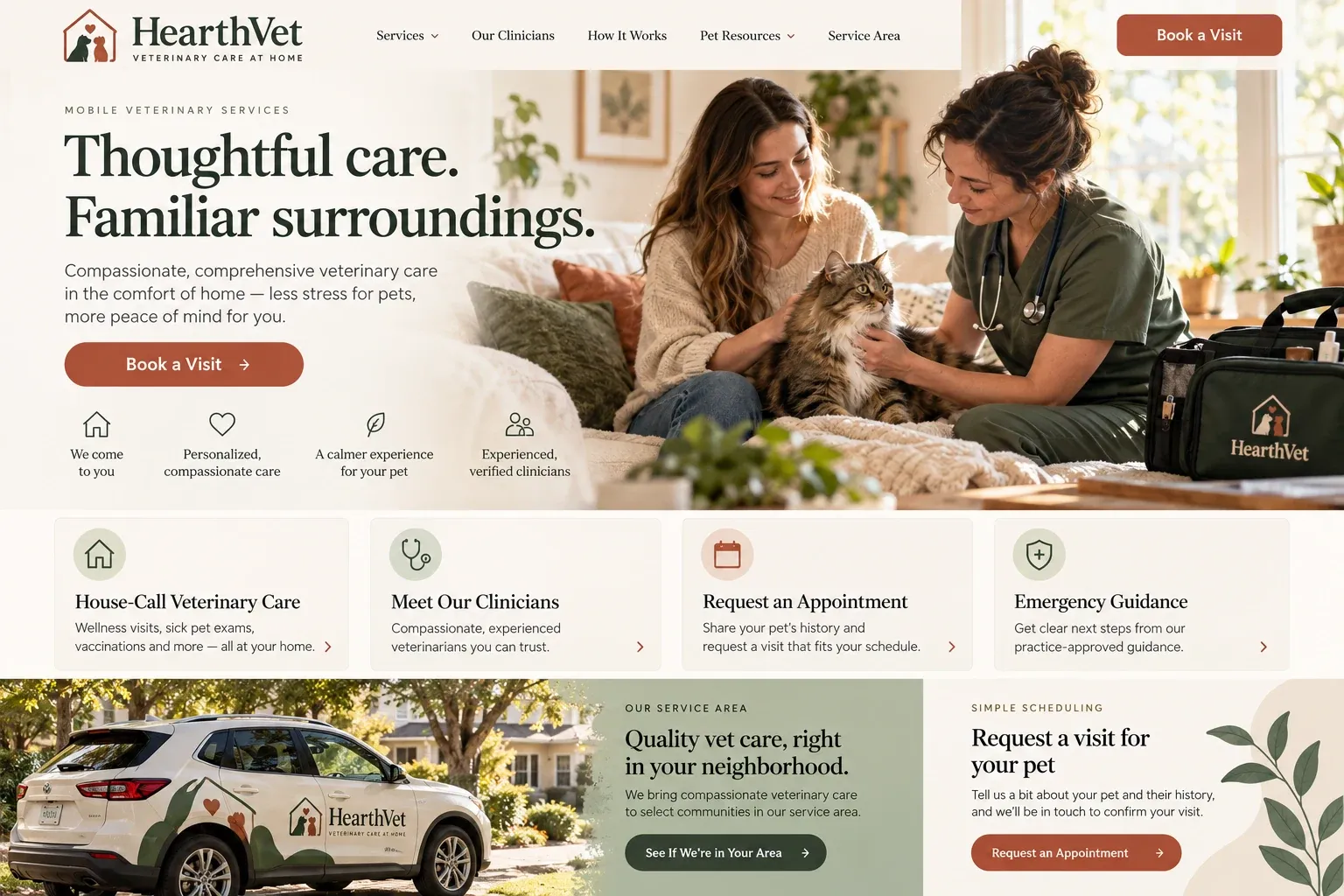
Fictional mobile veterinary services website design showing an at-home service
A design concept for a fictional brand. Your site is designed from scratch around yours.

Your customer's story

The cat who hides when the carrier appears

Pepper is fourteen and knows exactly what the carrier means. The moment Joanne lifts it down from the hall closet, the cat vanishes under the guest bed and stays there. Her annual checkup is overdue by months. Joanne has tried twice, and twice she has ended up with a scratched arm, a crying cat in the car, and a missed appointment. Tonight she searches "vet that comes to your house" instead.

The first practice she finds mentions house calls in a single line, with no word on where the team goes. The second wants her to download an app before it shows anything. The third has a map of the areas it covers, her part of Coral Gables included, a page on what a home visit involves, and a plain notice that it does not take emergencies, naming the nearest emergency animal hospital.

She reads the visit page twice. The vet arrives within a two-hour window, owners are asked to shut the cat in a small room beforehand, and there is a line on leaving the team's name with a building's front desk. She sends a request that evening. A mobile vet's website should do exactly this: show where the team goes, what a visit looks like, and where to turn when it cannot wait.

Why it matters

Why mobile veterinary practices need a website.

Owners who look for a house-call vet usually have a reason the clinic does not work for them: an anxious or aging pet, a household of several animals, no car, limited mobility, or a dog too big to lift into the car. They search with that reason in mind and want to know whether you come to them. A directory listing shows a name and a phone number. It cannot show your coverage, your visit routine, or the limits of care at home.

We build mobile veterinary sites around the visit itself. The coverage area comes first, with a map and a list of towns. A page explains how a home appointment runs, what to prepare, and how arrival windows work. Your clinicians are introduced with the credentials they hold. Requests go through a short form or your practice software's booking link, and a notice on every page says you are not an emergency service and where to go instead.

What your customers search for

  • mobile vet near me
  • vet that comes to your house
  • house call vet Miami
  • in-home pet euthanasia
  • mobile vet for cats
  • at home vet visit Miami

Your customers

What pet owners ask before booking a house-call vet

  • Do you come to my street?

    A coverage map with the cities and neighborhoods you visit, plus a note on gated communities and condo buildings, so owners know before they fill anything in.

  • What happens during a home visit?

    A plain walk-through of the visit: when the team arrives, how long it usually stays, what can be done in the home, and what needs a clinic.

  • Who is coming into my home?

    Profiles of each veterinarian and technician with photos, the credentials they hold, and the animals they see, so the person at the door is already familiar.

  • What if it is an emergency?

    A notice on every page that the practice does not take emergencies, with the name, address, and phone number of the nearest emergency animal hospital you recommend.

What we build

What a website for mobile veterinary practices should include.

  • House-call service pages

    Wellness visits, vaccines, senior pet care, and end-of-life visits, each described in plain words the veterinarian approves.

  • Visit area map

    A map of where the team drives, the towns listed in text, and any days you visit outlying areas.

  • Home visit checklist

    What to have ready: a quiet room, pets kept inside, records from a past vet, and a parking spot for the vehicle.

  • Short appointment request

    Owner name, phone, address, species, and a general reason picked from a list. Health histories stay in your practice software.

  • Emergency hospital notice

    A strip on every page stating that you do not handle emergencies, naming the nearest emergency animal hospital with a tap-to-call number.

  • Clinician profiles

    Each veterinarian and technician with a photo, the credentials they hold, the species they see, and a few words in their own voice.

Planning guide

What should a house-call veterinary practice put on its website?

A mobile vet's website answers questions a clinic's site never has to: do you come here, what do I prepare, and who knocks on the door. It also has to draw a firm line between a booked visit and an emergency. Here is how we plan the pages, what to show, how booking works, and how the practice gets found.

Pages that explain care at home

Start with a home page that says, in its first lines, that you are a mobile practice and where you go. Add a page for each kind of visit you offer, such as wellness exams, vaccines, senior pet care, multi-pet households, and end-of-life visits, written in plain words and approved by the veterinarian. A page on what can and cannot be done at home saves owners a wasted request, and an about page introduces the team.

Show the team, the vehicle, and the routine

Owners are letting strangers into the house, so faces matter. Use real photos of each clinician, the vehicle the team arrives in, and the equipment it carries. Describe the visit step by step: the arrival window, the text before the team sets off, how long a visit usually takes, and what happens with samples or follow-up. List only credentials you hold, leave out anything you cannot back up, and never promise an outcome.

Keep booking short and emergencies separate

Most mobile practices already use scheduling or practice management software. The site can link to its booking page or embed it, or offer a short request form that asks for the owner's name, phone, address, the number and kinds of animals, and a general reason picked from a list. Leave medical histories, medication lists, and records to your own software, where they belong.

Then make the emergency notice impossible to miss. A house-call team is often on the road and cannot drop everything, so every page should say plainly that the practice is not for emergencies and name the nearest emergency animal hospital, with its address and a tap-to-call number. The wording comes from you, and we place it where a worried owner will see it first.

Get found by owners in your coverage area

People search for "mobile vet near me" or "vet house call" plus their town. A page for each area you cover, with the visits you offer there, gives search engines something specific to match. Keep your business name, phone number, and service area consistent with your Google Business Profile, set up as a service-area business, and ask happy clients for reviews. None of it promises a ranking, but it gives a careful practice a fair start.
In your market

Built for house-call vet care in South Florida

South Florida suits house calls in some ways and tests them in others. Many owners live in condos with front desks, elevators, and visitor rules, or in gated communities that need a name at the gate. Summer heat makes a car ride harder on older pets, and afternoon storms can push arrival windows back. Hurricane season brings questions about pet records before an evacuation. We write those details into the visit page and can add a Spanish version for bilingual households.

Questions

Questions mobile veterinary practices ask us.

How should a mobile vet website handle emergencies?

Plainly. Every page carries a short notice that the practice does not handle emergencies, with the name, address, and tap-to-call number of the emergency animal hospital you choose. You write or approve the wording, and if you change your referral hospital, we update the notice across the site.

Can clients book house-call vet visits online?

Yes, through the tool you already use. If your practice software or scheduling app has an online booking page, we link to it or embed it. Otherwise a short request form collects the owner's contact details, address, animals, and a general reason, and your team calls back to set the arrival window. Health histories stay in your own system.

Should our mobile veterinary site talk about end-of-life visits?

If you offer them, yes, gently and on their own page. Families often search for this at a hard moment and want to know it can happen at home. We write it with you in quiet, plain language, explain how to arrange a visit, and keep the page free of sales wording. You approve every line before it goes live.

How do we show which areas our house-call vets cover?

With a map and a written list of towns and neighborhoods, since owners often search by place name. If you visit some areas only on certain days, or need extra notice for farms and outlying neighborhoods, we say so. A note on gated communities and condo buildings tells owners what access details to send with their request.

Let's talk

Ready for a website built for mobile veterinary practices?

Tell us about your business and we will come back with a clear recommendation and a fixed quote. No pressure, no jargon.

Trades we design for

See all 226 trades

226 trades

  • Plumbers website design concept
CallFree quote