Web design for notaries and mobile notaries

Website design for notaries and mobile notaries.

Nobody plans to need a notary. A form arrives with a signature line and a stamp box, and suddenly someone needs to know who can do it today, where, and what to bring.

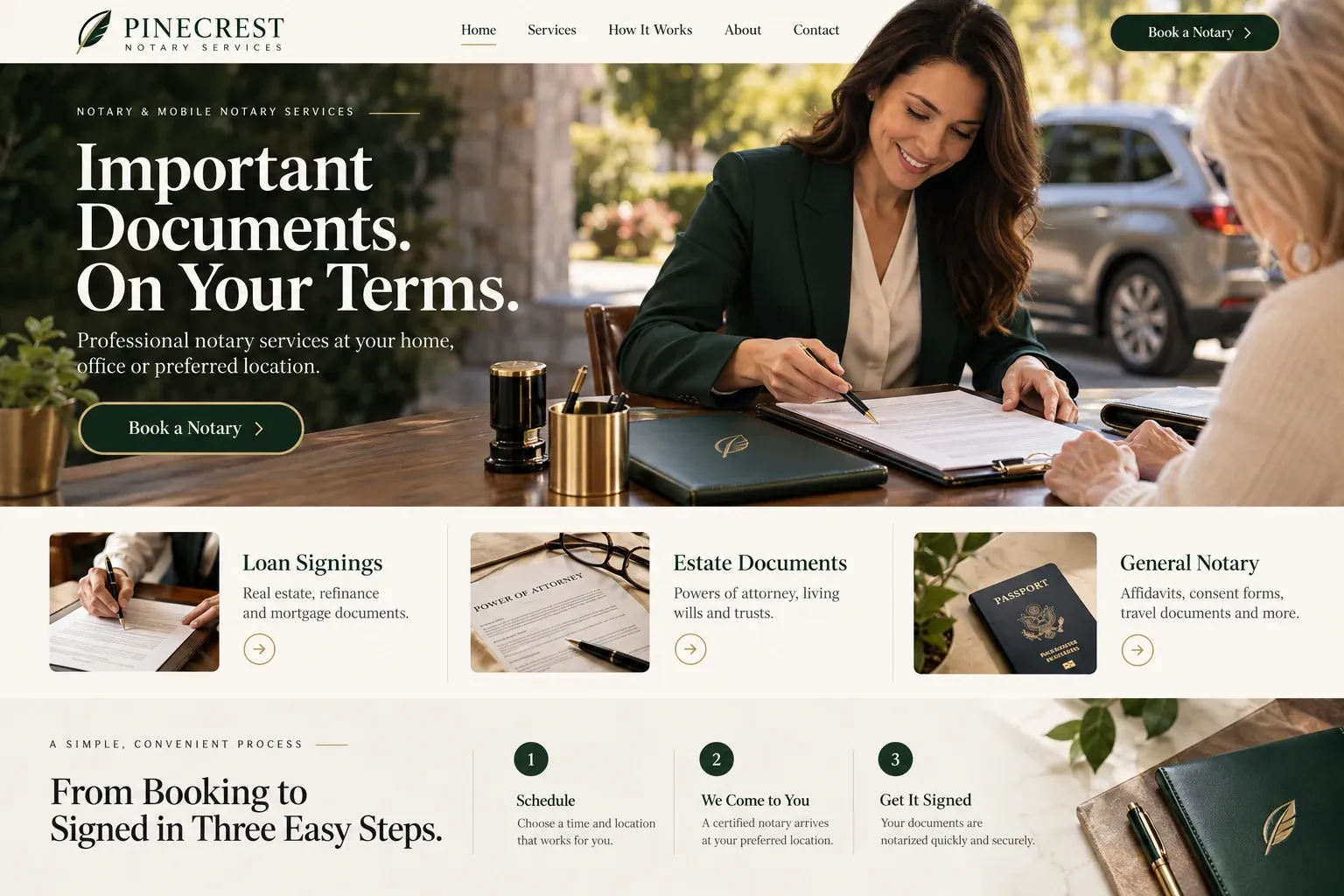
Fictional notary and mobile notary services website homepage design concept
A design concept for a fictional brand. Your site is designed from scratch around yours.

Your customer's story

A travel consent letter due before Friday's flight

Paola is taking her two kids to see their grandparents in Bogotá on Friday, and the travel agent reminds her to bring a consent letter signed by their father and notarized. Their father works nights at the port and sleeps through banking hours. It is Tuesday afternoon. Paola searches "mobile notary near me" while waiting in the school pickup line, one eye on the car ahead.

One listing shows only a phone number that goes to voicemail. Another site lists services but not where the notary travels or whether evenings are possible. The third says it covers Miami-Dade with evening and weekend visits and explains what the signer needs to bring, starting with a current photo ID. A short request form asks for the document type, the address, and a preferred time.

Paola fills in the form with Wednesday evening and the father's apartment in Doral, and a reply comes within the hour confirming the visit and the travel fee. On Friday she boards with the letter in her bag. A notary's website should handle exactly that kind of errand: where you go, when you can come, what to prepare, and a fast way to ask.

Why it matters

Why notaries and mobile notaries need a website.

Notary customers search in a hurry and on a phone. They need a closing document signed, a power of attorney for a parent, a vehicle title, a consent letter, or a stack of loan papers, and they need it soon. A directory listing rarely says where a mobile notary travels, which hours are available, or what the signer must bring. Without those answers, people call the next name rather than leave a voicemail.

We build notary websites that answer the errand in one screen. Office and mobile options sit side by side, with your travel area on a map and your hours, including evenings or weekends if you offer them. A preparation page, written and approved by you, covers ID and document readiness. The appointment request collects the document type, location, and time, and a tap-to-call button stays visible for same-day needs.

What your customers search for

  • mobile notary near me
  • notary public Miami
  • loan signing agent
  • power of attorney notary
  • hospital notary service
  • travel consent letter notarized

Your customers

What people need to know before booking a notary

  • Can you come to me?

    Your mobile coverage on a simple map or list, with any travel fee explained and whether you visit homes, hospitals, offices, or care facilities.

  • Are you available tonight?

    Office hours, mobile hours, and whether you take evening, weekend, or same-day requests, kept current so nobody drives to a closed door.

  • What do I need to bring?

    Your own preparation checklist, such as acceptable ID and how to arrange witnesses if a document calls for them, written and approved by you.

  • Can you handle my kind of document?

    Pages for loan signings, real estate closings, powers of attorney, vehicle titles, and travel consent letters, describing the appointment, not the law.

What we build

What a website for notaries and mobile notaries should include.

  • Office and mobile options

    Two clear choices on the home page, each with hours, location or coverage, and how to book.

  • Travel area map

    The cities and neighborhoods you travel to, with any travel fee explained, so callers know before they ask.

  • Provider-approved preparation

    A checklist for signers in your own words, covering ID, document readiness, and witnesses, reviewed by you before launch.

  • Appointment request form

    Document type, number of signers, address, and preferred time, sent to your email so you can confirm from your phone.

  • Loan signing page

    A page for title companies and lenders describing your signing experience, availability, and how to send closing documents.

  • Bilingual pages

    English and Spanish versions, with a plain note that you notarize signatures and do not give legal advice.

Planning guide

What does a notary or mobile notary website need?

A notary website is judged in under a minute, usually on a phone, by someone with a document in hand and a deadline. It should answer where, when, how much travel is involved, and what to bring, then make booking easy. These four parts cover the pages, the preparation content, the booking flow, and local visibility.

Pages built around documents and places

Most notary customers search by document or situation: loan signing, power of attorney, vehicle title, travel consent, hospital visit. Give your main services short pages that describe the appointment, who usually needs it, and where you can meet. Add pages for remote online notarization if you are registered for it, and for apostille help if you offer it. A clear coverage page completes the core.

Write preparation notes you have approved

Preparation content saves you wasted trips, but it must be yours. List the forms of ID you accept, how to handle witnesses if a document needs them, and what you ask signers to have ready. Avoid general statements about whether a document is valid or what it should say; that is legal territory, and the site should send those questions to an attorney.

This matters even more in Spanish. In many Latin American countries a notario is a legal professional, so some clients expect advice that a notary public here, unless also an attorney, cannot give. A short, friendly note on every page, in both languages, sets the right expectation from the start and protects you and your clients.

Make booking quick for urgent errands

Put a tap-to-call button on every page and say when you answer. The request form should ask for the document type, the number of signers, the address or preferred location, and a time window. Do not ask people to upload their documents through the form. If you use a scheduling tool such as Calendly or Square Appointments, the site can embed it for routine office visits. Confirm every appointment by text or email so the signer knows when you will arrive.

Show up for near me searches

"Notary near me" and "mobile notary" plus a city are typical searches. A coverage page that names your cities and neighborhoods, consistent details on your Google Business Profile, and accurate hours give search engines what they need. Keep holiday hours updated too. Ask satisfied signers for reviews; title companies and repeat clients often mention punctuality, which is exactly what new customers want to read.
In your market

Built for notary work in South Florida

Notaries in South Florida handle a steady flow of real estate closings, loan signings, and powers of attorney, plus travel consent letters for families flying to Latin America and documents for relatives abroad. Seasonal residents need signings before they head north, and care facilities and hospitals call for mobile visits. Many signers prefer Spanish or Haitian Creole. We can build the site in English and Spanish and show your coverage across Miami-Dade, Broward, and beyond.

Questions

Questions notaries and mobile notaries ask us.

Should a mobile notary website list a travel fee?

If you charge one, saying so up front prevents awkward calls. Many notaries explain how the travel fee works, by distance or zone, without a full price list. You decide what to publish, and we keep it on the coverage page so people see it next to the map of where you go.

Can our notary site take same-day appointment requests?

Yes. The form arrives in your email at any hour, and a tap-to-call button handles the urgent cases. If you want routine office visits booked automatically, we can embed a scheduling tool. For mobile visits, many notaries prefer to confirm by phone first, so the form asks for a callback number.

How do we keep a notary website from sounding like legal advice?

By describing appointments, not documents. Pages explain what happens when you meet, what to bring, and where you travel. Questions about what a document should say or whether it is valid are pointed to an attorney. You approve every line, and we add a plain note, in English and Spanish, that you do not give legal advice.

Should loan signing work have its own page on our notary site?

Yes, if you want more of it. Title companies and signing services look for availability, experience with closing documents, and how to send assignments, which is different from what a family needing one signature wants. A separate page speaks to each audience without cluttering the other.

Let's talk

Ready for a website built for notaries and mobile notaries?

Tell us about your business and we will come back with a clear recommendation and a fixed quote. No pressure, no jargon.

Trades we design for

See all 226 trades

226 trades

  • Plumbers website design concept
CallFree quote