Web design for translation and interpreting services

Website design for translators and interpreters.

Someone who needs a birth certificate translated and someone who needs an interpreter for a deposition both search for language help. They need different things, and your website has to send each of them down the right path.

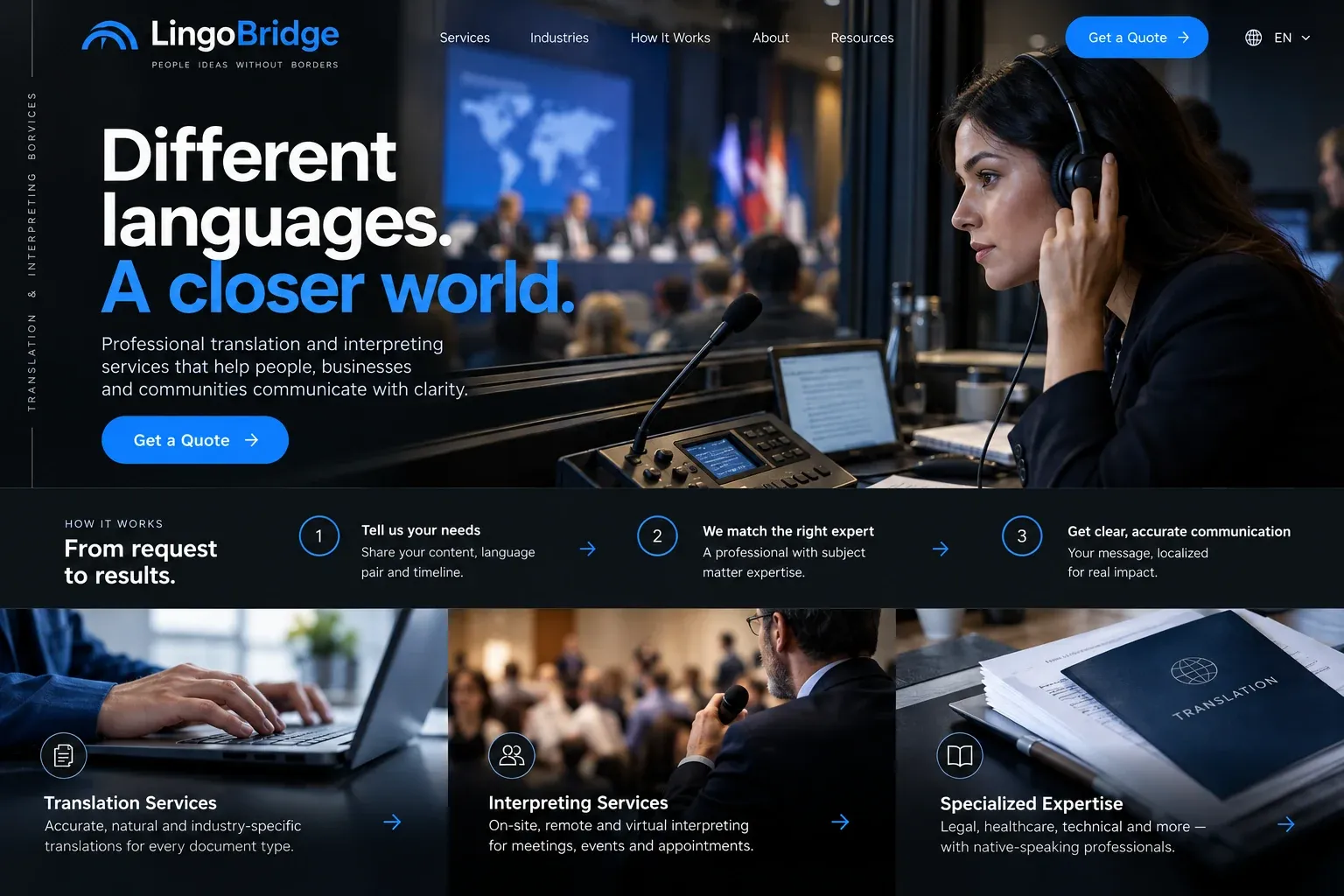
Fictional translation and interpreting services website homepage design concept
A design concept for a fictional brand. Your site is designed from scratch around yours.

Your customer's story

A nursing diploma from Caracas needs English

Andrés trained as a nurse in Caracas and has been working as a medical assistant in Hialeah while he prepares to get licensed here. The credential evaluation service he applied to wants certified English translations of his diploma and transcripts. His cousin offers to translate them for free, but Andrés is not sure that counts. At lunch he searches "certified translation near me" on his phone.

The first agency lists forty languages and conference interpreting but says nothing about documents like his. The second has a contact form and a stock photo of flags. The third has two clear doors on its home page: written translation and interpreting. Behind the first door is a page on certified document translation that explains what the certification statement is and asks him to send clear scans through a secure upload link.

It lists Spanish to English among the pairs it actually handles, explains that quotes depend on the number of pages and the deadline, and says when he will hear back. Andrés sends his files before his lunch break ends. A translation and interpreting website should make that first choice obvious, then ask for just what is needed to quote the job accurately.

Why it matters

Why translation and interpreting services need a website.

Language services cover very different jobs: certified documents for immigration or school, legal and medical translation, website localization, court and medical interpreting, conference interpreting, and remote video sessions. Clients often do not know the difference between translation and interpreting, let alone which credentials matter. A directory listing shows a name and some languages. It cannot route a visitor to the right service, show which language pairs you truly cover, or collect what a quote needs.

We build language service websites with two clear routes from the first screen: written and spoken. Each service has a page that explains format, preparation, and what affects the quote. Your language pairs are listed honestly, with notes where you work through partner linguists. Translation requests can point to a secure file upload, interpreting requests ask for date, setting, and duration, and the whole site can be published in Spanish as well as English.

What your customers search for

  • certified translation near me
  • Spanish interpreter Miami
  • birth certificate translation
  • Haitian Creole translator
  • document translation for immigration
  • remote video interpreting

Your customers

What clients ask a translation or interpreting service first

  • Is this translation or interpreting?

    A home page that splits written and spoken work at once, with one line explaining each, so nobody books the wrong service.

  • Do you cover my language?

    Language pairs listed exactly as you offer them, by direction, with any specialties such as legal, medical, or technical noted beside each.

  • Will it be accepted where I need it?

    A page explaining what your certified translations include, such as a signed statement of accuracy, while telling clients to confirm requirements with the receiving office.

  • How do I get a quote?

    A short request flow that asks for document type, page count, deadline, and purpose, or for interpreting, the date, place, and setting.

What we build

What a website for translation and interpreting services should include.

  • Written and spoken routes

    Two clear paths from the home page, one for document translation and one for interpreting, each with its own request form.

  • Honest language coverage

    Pairs and directions you genuinely handle, with specialties and any work done through vetted partner linguists noted.

  • Certified translation page

    What your certification includes, common document types, and a reminder to check the receiving office's requirements.

  • Secure file upload link

    A link to the file-sharing tool you trust for passports, records, and contracts, instead of loose email attachments.

  • Interpreting request form

    Date, location or video platform, setting, expected length, and languages, so you can match the right interpreter.

  • Fully bilingual site

    Every page in English and Spanish, so clients can read about your services in the language they are most comfortable with.

Planning guide

How should a translation and interpreting service plan its website?

A language service website succeeds when a confused visitor leaves knowing which service they need and how to request it. That depends on structure more than style. This guide covers dividing written and spoken work, presenting languages and credentials honestly, handling files and requests safely, and helping people in your area find you when the need is urgent.

Divide the site into written and spoken

Translation and interpreting differ in format, timing, and preparation, so give each its own section. Under translation, add pages for certified documents, legal, medical, business, and website localization, as you offer them. Under interpreting, separate on-site, over-the-phone, and video work, and settings such as legal, medical, community, or conference. Each page says what the client should prepare and what affects the quote. A short comparison on the home page helps too.

Present languages and credentials truthfully

List language pairs by direction, because Spanish into English and English into Spanish may involve different linguists. If you rely on partners for some languages, say so rather than implying an in-house team of dozens. Show credentials that are real and checkable, such as certification from a recognized body or court interpreter credentials where your interpreters hold them.

For certified translations, explain what the certification consists of in your practice, for example a signed statement of accuracy, and whether you can arrange notarization. Avoid promising acceptance by any agency or court. Instead, encourage clients to check what the receiving office requires and offer to help them read the instructions they were given.

Handle documents and bookings with care

People send passports, medical records, and contracts for translation. A normal contact form that emails attachments is a poor fit for those. Link instead to a secure upload tool you already use, and keep the website form to contact details, document type, language pair, page count, and deadline. Interpreting requests need the date, time, location or video platform, setting, and expected length. Say when clients will hear back.

Get found when the need is urgent

Many language searches are urgent and local: "certified translation near me", "Spanish interpreter Miami", "Haitian Creole translator". Pages for each service and each main language give search engines precise matches. Keep your Google Business Profile complete, including hours and whether walk-ins are welcome. Reviews that mention a language or document type help future clients judge fit, and a Spanish version of the site reaches people searching in Spanish.
In your market

Built for language services in South Florida

South Florida runs on more than one language. Spanish is everywhere, and Haitian Creole, Portuguese, and French are common in homes, clinics, and courtrooms. Immigration paperwork, international trade, cruise and tourism business, and cross-border family matters keep translators and interpreters busy year round. Clients often prefer to read your site in their own language. We write clear pages for both kinds of work and can publish the whole site in Spanish.

Questions

Questions translation and interpreting services ask us.

Should our translation website list every language we can source?

List the pairs you handle confidently, by direction, and say plainly if some come through partner linguists. Clients prefer an honest list over a long one that leads to disappointment. For rare languages, a line inviting people to ask works well, so you can check availability before promising anything.

How can clients send documents for translation safely through the site?

We usually link to the secure file-sharing or client portal tool you already trust, rather than having the website form email attachments. The form collects contact details, language pair, document type, and deadline, and the upload link handles the files. That keeps passports and records out of ordinary email.

Can the site explain what a certified translation is without giving legal advice?

Yes. We describe what your certified translations include, in your words, and add a plain note that requirements vary by receiving office, so clients should check theirs. The site never promises acceptance. You approve the wording, and we keep it general enough to stay accurate as rules change.

Should interpreting and translation have separate contact forms?

Yes. A translation request needs document type, language pair, length, and deadline. An interpreting request needs the date, time, place or video platform, setting, and how long the session should last. Two short forms ask better questions than one long one, and each arrives in your inbox labeled so you can route it quickly.

Let's talk

Ready for a website built for translation and interpreting services?

Tell us about your business and we will come back with a clear recommendation and a fixed quote. No pressure, no jargon.

Trades we design for

See all 226 trades

226 trades

  • Plumbers website design concept
CallFree quote