Web design for demolition contractors

Websites that make demolition look as planned as it is.

Demolition is the step that makes room for everything after it. Owners and builders hiring for it want proof of a clear scope, a clean handover, and a crew that takes out only what is supposed to go.

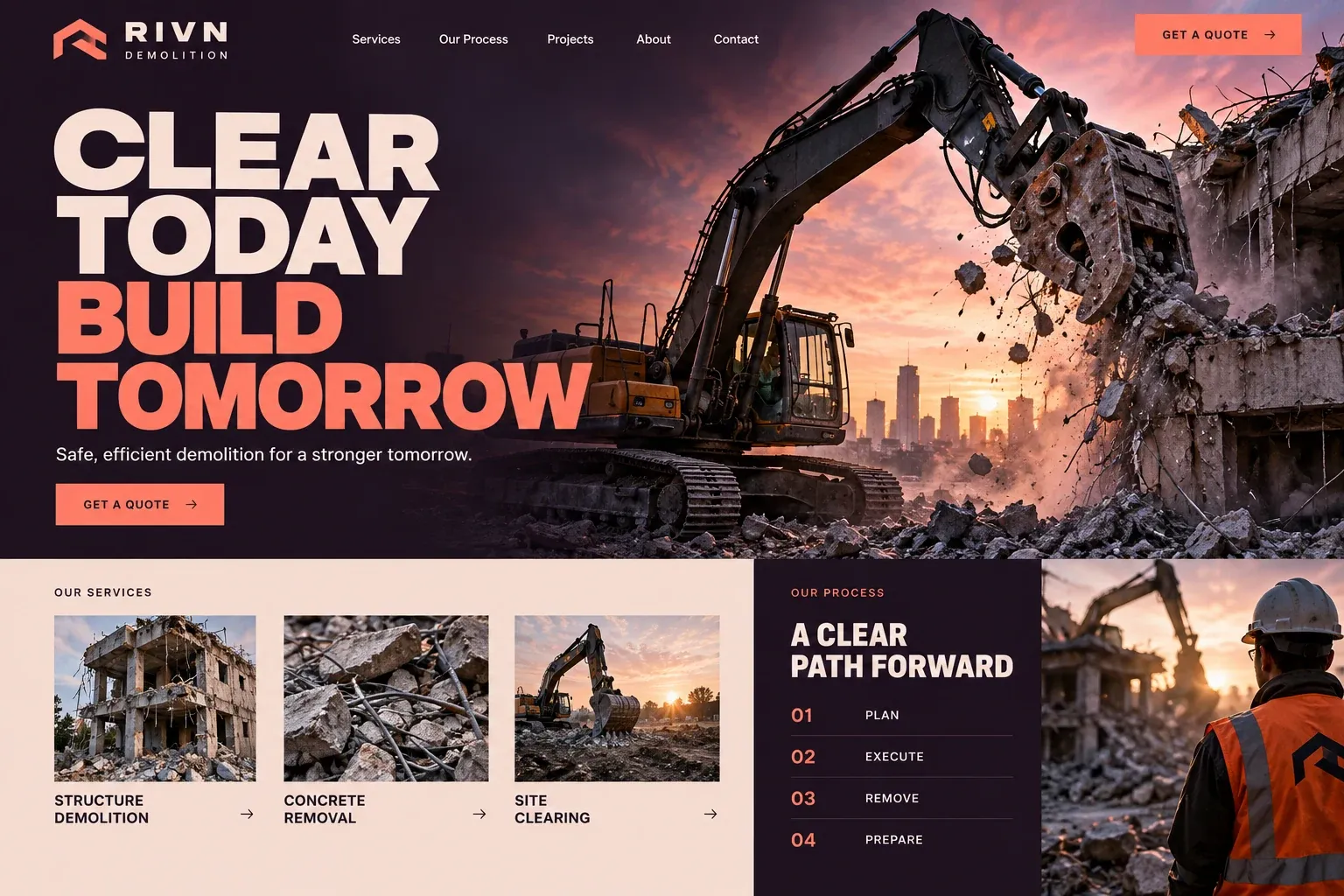
Fictional demolition contractors website homepage design concept
A design concept for a fictional brand. Your site is designed from scratch around yours.

Your customer's story

Lease signed, old kitchen still in the way

Jasmine signs the lease on a former restaurant in a busy shopping plaza. In a few months it will be a cycling studio, but for now it still has a commercial kitchen, a walk-in cooler, two restrooms in the wrong place, and a tile floor stuck to the slab. Her build-out contractor has a start date. Everything old has to be gone before it.

The landlord has rules too: the storefront glass and the sprinkler lines stay, noisy work happens after the other shops close, and the dumpster goes behind the building. Jasmine searches for interior demolition contractors and finds sites full of wrecking balls and collapsing buildings. One company has a selective demolition page with photos of gutted retail spaces, clean slabs, and capped utilities, and a list of what it protects.

Its project form asks for the address, the floor plan if she has one, what must stay, the landlord's work-hour rules, and the next contractor's start date. She uploads the plan and the landlord's letter. A demolition contractor's website wins work like this by making removal look like the careful first stage of a project, with a scope everyone can read, not a show of force.

Why it matters

Why demolition contractors need a website.

Demolition buyers are rarely buying demolition for its own sake. They are clearing the way for a remodel, a tenant build-out, a new home, or a sale, and someone else is waiting to start. What they need to see is control: a defined scope, protection for what stays, debris handled, and a site handed over on time. Videos of buildings falling make good social media, but they say little about an interior strip-out in an occupied plaza.

We build demolition websites that separate the work by scale. Selective and interior demolition gets its own pages, apart from full structure removal, so a tenant and a developer each find their match. A scope page explains how you assess a job, including any testing older buildings may need. Project pages show what was removed and what was protected. The request form collects plans, access details, and the next trade's schedule.

What your customers search for

  • demolition contractor near me
  • interior demolition Miami
  • commercial strip out contractor
  • kitchen demolition service
  • house demolition cost
  • selective demolition contractor

Your customers

What clients need settled before demolition starts

  • What exactly comes out?

    A scope page explaining how you define removal in writing, room by room or item by item, and confirm it with the owner before work begins.

  • What stays protected?

    Photos and notes on how you protect floors, storefronts, neighboring units, and utilities that remain, so owners know the plan for what must survive.

  • Does the building need testing first?

    A general note that older buildings may need checks for materials such as asbestos or lead paint, and how you arrange or coordinate that step.

  • Will you be out before my contractor arrives?

    A page on how you schedule around the next trade, haul debris, and leave the space swept and ready, with real handover photos.

What we build

What a website for demolition contractors should include.

  • Selective demolition examples

    Interior strip-outs, kitchen and bath tear-outs, and tenant space clearing shown separately from whole-structure work, with before and after photos.

  • Scope assessment page

    How you walk a site, what you need to see, and how the written scope is agreed before any equipment arrives.

  • Site-access questions

    The form asks about loading areas, elevators, work-hour limits, dumpster placement, and neighbors, the details that shape a demolition plan.

  • Project-plan inquiry

    Owners and builders upload floor plans, photos, and landlord rules, and name the next contractor's start date.

  • Debris and recycling notes

    What you haul, what you separate for recycling or salvage, and how the site is left, stated plainly for owners who ask.

  • Licensing and insurance details

    Your license number, where it applies, and insurance details, shown where property managers and general contractors expect to find them.

Planning guide

What should a demolition contractor's website explain to clients?

Many owners hiring a demolition contractor are doing it for the first time, and the stakes feel high: a wall removed by mistake, a delayed build-out, a neighbor's complaint. A demolition website should replace that worry with a clear picture of scope, process, and handover. Here is what to plan, page by page, and how it helps the right clients find you.

Sort the work by scale and setting

Interior selective demolition, residential tear-outs, commercial strip-outs, and full structure removal draw different clients with different fears. Give each its own page with photos from your jobs and a short account of how that work is planned. A homeowner gutting a kitchen should not have to scroll past a three-story teardown to find you. Add a scope and process page, an about page, and a contact page.

Make the scope readable before the visit

A good scope page tells clients how you decide what comes out and what stays, how that is written down and agreed, and what happens when something unexpected turns up behind a wall. Mention, in general terms, that older buildings may need testing for hazardous materials before work starts, and explain how you handle or coordinate it. Do not imply that every job is simple or that every building suits your crew.

Photograph what was removed and what was saved

Demolition photos are most convincing in pairs: the space before, and the space handed over, swept, with utilities capped and protected items intact. Include shots of protection in place, such as floor coverings, sealed doorways, or a storefront boarded from inside. Caption each project with the setting, what was removed, and what had to stay. Use only your own jobs, and never borrow dramatic footage from elsewhere.

Collect the details and help clients find you

The request form should gather the facts that shape a demolition plan: the address, type of building, what must come out, what must stay, access and loading, building or landlord rules, and the next contractor's start date. Let clients upload floor plans and photos. Keep a direct number on every page, since general contractors often need a quick answer before they commit to a schedule.

For search, use the terms clients type: "interior demolition", "kitchen demolition", "commercial strip-out", "house demolition". Each service page gives Google something specific to match, and naming the cities you serve tells it where you belong. Keep your Google Business Profile in step with the site and ask builders and property managers for reviews. That gives a careful crew a fair chance to be found, without any promise of position.
In your market

Built for demolition in South Florida

South Florida's constant remodeling keeps interior demolition busy: condo renovations, restaurant turnovers, retail build-outs, and older homes cleared for new construction. Condo and office jobs come with building rules on work hours, elevator use, and debris removal, and many older structures call for material testing before work begins. Hurricane season can also bring urgent removal of damaged structures. Your site can address each of these directly, in English and Spanish.

Questions

Questions demolition contractors ask us.

Should a demolition website show dramatic teardown videos?

Use them sparingly. Many demolition clients are hiring careful interior or selective work, and they want to see control: protection in place, clean slabs, capped utilities, a space ready for the next trade. A full teardown video can sit on its own project page for clients who need that scale.

How do we describe hazardous material testing without overpromising?

In general terms. We say that older buildings may need testing before demolition and explain how your company arranges it or works with specialists, without quoting rules or promising outcomes. You review the wording, and if a client's job needs more detail, it belongs in your written proposal.

Can clients upload floor plans with a demolition request?

Yes. The form accepts plans, photos, and documents such as a landlord's work rules, along with questions about access, what stays, and the next contractor's start date. Requests reach your email complete, so the first site walk is about confirming scope rather than gathering basics.

Should residential and commercial demolition have separate pages?

Yes. A homeowner removing a kitchen worries about dust and the rest of the house, while a tenant or developer worries about landlord rules, schedules, and the next trade. Separate pages with fitting photos speak to each, and they give search engines distinct topics to show.

Let's talk

Ready for a website built for demolition contractors?

Tell us about your business and we will come back with a clear recommendation and a fixed quote. No pressure, no jargon.

Trades we design for

See all 226 trades

226 trades

  • Plumbers website design concept
CallFree quote