Web design for grant writers

Websites for grant writers that show the work behind the ask.

Nonprofits usually look for a grant writer when a deadline is close and the team is stretched. They need to see quickly what you do, what they must supply, and whether you have room before the due date.

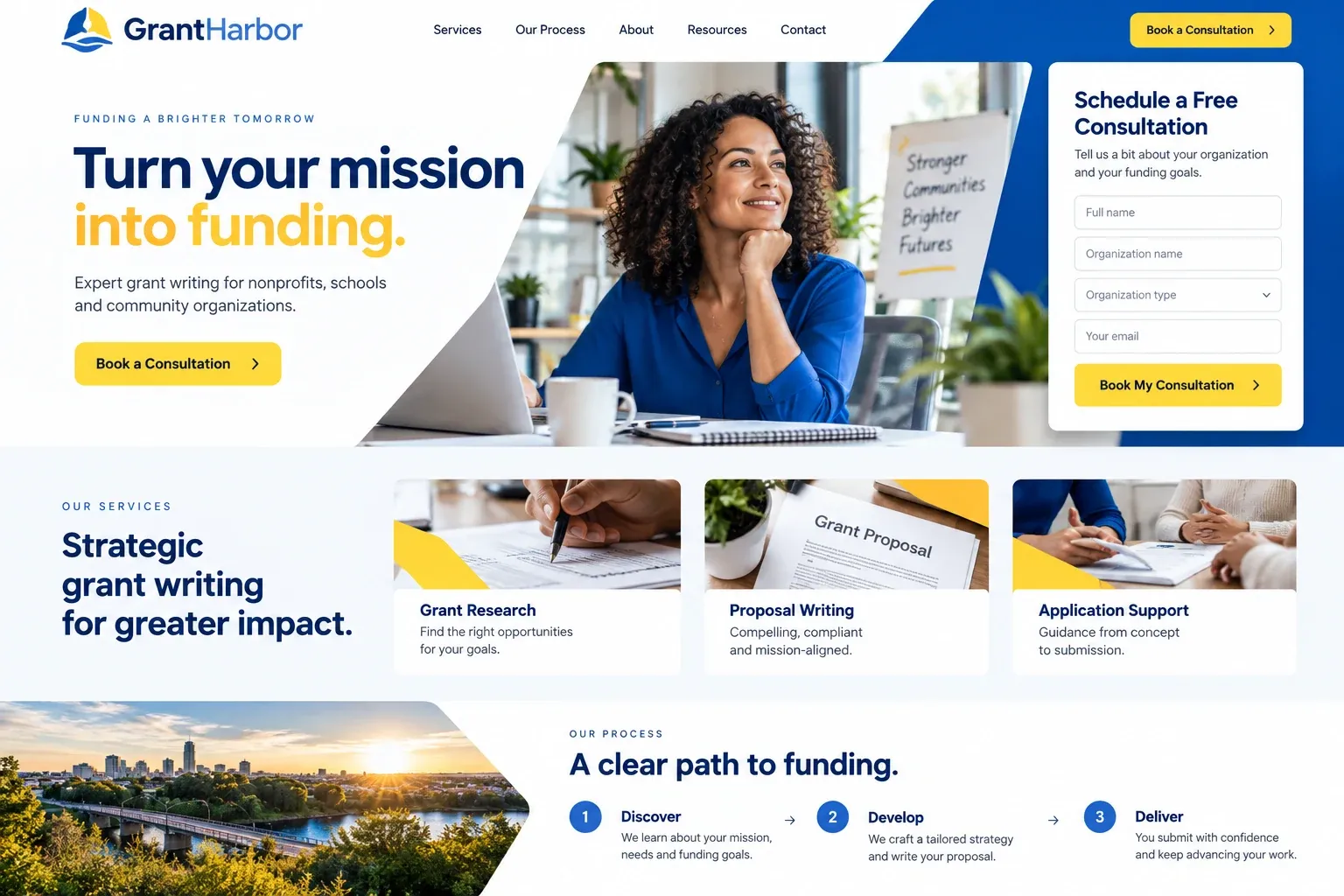
Fictional grant writers website homepage design concept
A design concept for a fictional brand. Your site is designed from scratch around yours.

Your customer's story

The foundation deadline is in five weeks

Marcia runs a small after-school literacy program out of a church hall, with two paid staff and a lot of volunteers. A community foundation has opened a grant round that fits them perfectly, and the board chair forwards it with three exclamation marks. The application is due in five weeks. Marcia has written newsletters, never a proposal, and she knows the program deserves better than her first try.

She searches "grant writer for small nonprofit" that evening. Several sites promise to win funding and show totals raised, which makes her uneasy. One grant writer's site is different. It explains what she does, from prospect research to drafting and editing, lists exactly what the client must provide, such as a budget, outcomes data, and a board list, and states plainly that no writer can promise an award.

Her inquiry form asks for the funder, the deadline, the program, and which documents are ready. Filling it in shows Marcia what she still has to gather, and she starts a list for the board. A grant writer's website should do that: set out the collaboration honestly, show the work behind a strong application, and help a client see whether they are ready.

Why it matters

Why grant writers need a website.

Grant writing is hired by nonprofits, schools, clinics, arts groups, tribal organizations, and small public agencies, and they rarely hire on impulse. An executive director or board member compares a few writers, checks writing samples and references, and worries about cost, deadlines, and ethics. A LinkedIn profile or freelance marketplace page shows a summary and a rating. It cannot explain your process, set out what the client must provide, or take an inquiry built around a real deadline.

We build grant writer websites that read like a well-organized proposal. Services such as prospect research, full applications, editing, letters of inquiry, and grant calendars each get a clear description. A preparation page lists what clients supply. Your stages, from intake to submission support, are laid out plainly, and the readiness inquiry captures funder, deadline, and documents so your first call is productive. Nothing on the site promises an award.

What your customers search for

  • grant writer for nonprofits
  • grant writing services
  • freelance grant writer
  • foundation grant proposal help
  • federal grant writing consultant
  • grant research services

Your customers

What nonprofits ask before hiring a grant writer

  • What will you actually do?

    A service list that separates prospect research, new applications, rewrites, editing, letters of inquiry, and reporting, so clients can hire exactly what they need.

  • What do we need to give you?

    A preparation checklist covering budgets, financial statements, outcomes data, program descriptions, board lists, and letters of support, with notes on why each matters.

  • Can you meet our deadline?

    A short note on how much lead time you prefer, how rush requests are handled, and an inquiry form that asks for the due date first.

  • How do you charge?

    A plain statement of how you bill, such as hourly or by project, and whether you accept payment tied to awards, which many grant professionals decline.

What we build

What a website for grant writers should include.

  • Service scope pages

    Research, writing, editing, and reporting described separately, each with what is included and what the client keeps.

  • Client preparation checklist

    The documents and data you need from the organization, listed plainly so teams can start gathering before the first call.

  • Deliverable stages

    Intake, outline, first draft, revisions, final draft, and submission support, shown in order with who does what.

  • Project readiness inquiry

    Funder, deadline, program, budget status, and available documents, so you can judge fit and timing before replying.

  • Writing samples, with permission

    Excerpts or redacted sections from past proposals that clients have approved, showing your voice and structure.

  • Sector pages

    Short pages for the fields you know, such as education, health, arts, or housing, and the funder types you work with.

Planning guide

How can a grant writer's website attract ready clients?

Grant writing clients arrive with a mix of hope and anxiety: a funding opportunity, a deadline, and doubts about whether they are ready. A good website calms that by explaining exactly what you do, what they must do, and how the work unfolds. Below are the pages to plan, the proof to show, the inquiry to build, and how clients find you.

Separate each service and its deliverables

Prospect research, a full new application, a rewrite of a declined proposal, a letter of inquiry, editing, and post-award reporting are different jobs with different effort. Give each a short page or section: what it involves, what the client receives, and roughly how much lead time it needs. If you specialize in federal, state, foundation, or corporate funders, say so; specialists are easier to choose.

Show proof without promising awards

Funding results are the proof everyone wants, and the easiest to misuse. If you mention awards, describe them accurately and with client permission, and make clear the organization's own work earned them alongside yours. Better still, show writing samples clients have approved, short testimonials from real executive directors, and your background in the sector. Say clearly that funding decisions rest with the funder.

Be open about how you charge. Many grant professionals do not work for a share of the award, and saying so up front answers a question many nonprofits are unsure how to ask. You do not have to publish rates, but explaining whether you bill hourly, by project, or on retainer helps clients budget for your help.

Turn the inquiry into a readiness check

A readiness inquiry asks for the funder or opportunity, the deadline, the program or project, and which documents already exist: budget, audited financials, outcomes data, board list, letters of support. Clients learn what they are missing, and you learn whether the timeline is realistic. Add a note on how much lead time you prefer, and reply with a clear yes, no, or not yet.

Reach organizations searching by sector

Nonprofit leaders search by need and sector: "grant writer for arts nonprofit", "federal grant writing help", "grant writer for schools". Sector pages and service pages give search engines precise topics, and a few helpful articles on preparing for a grant round show your expertise. Because the work happens by email and video, your site can serve organizations anywhere; mention the regions you know best. Membership directories from nonprofit associations can link back to your site as well.
In your market

Built for grant writers serving clients anywhere

Grant writing travels well. Interviews happen by video, drafts move through shared documents, and submissions go through online portals, so a writer in one state can serve organizations across the country. That widens your market and your competition at once, which makes a clear, credible website more important than a local office. We work with grant writers anywhere by phone, video, and email, and can add a Spanish version for organizations serving Spanish-speaking communities.

Questions

Questions grant writers ask us.

Can a grant writer's website mention awards our clients received?

Yes, with each client's permission and accurate wording. Describe the funder type, the program, and your role, and make clear that the organization's work and the funder's priorities decided the outcome. Avoid totals that could read as a promise. Many writers pair a short results list with approved writing samples instead.

Should our grant writing site explain what clients need to prepare?

Yes, and it is one of the most useful pages you can have. A clear checklist of budgets, financials, outcomes data, board lists, and support letters helps organizations judge their own readiness, saves your first call from basics, and shows that you run projects in an organized way.

How do we show grant writing samples without breaking confidentiality?

Use excerpts that clients have approved, or redact names and figures from a past proposal. A sample need section, a logic model, or an evaluation plan shows your structure and voice well. We can present them as short readable extracts or downloadable PDFs, whichever suits your clients' wishes.

Can the site help us turn away grant projects that come too late?

It can set expectations before anyone writes to you. A note on your preferred lead time and a readiness form that asks for the deadline first let organizations see whether they are early enough. When a request is too tight, you reply knowing the facts and can suggest a future round instead.

Let's talk

Ready for a website built for grant writers?

Tell us about your business and we will come back with a clear recommendation and a fixed quote. No pressure, no jargon.

Trades we design for

See all 226 trades

226 trades

  • Plumbers website design concept
CallFree quote