Web design for real estate appraisers

Clear websites for real estate appraisers.

Private clients rarely order more than one appraisal in their lives. They need to know which kind of report fits, whether you cover their property, and what to have ready, long before anyone talks about value.

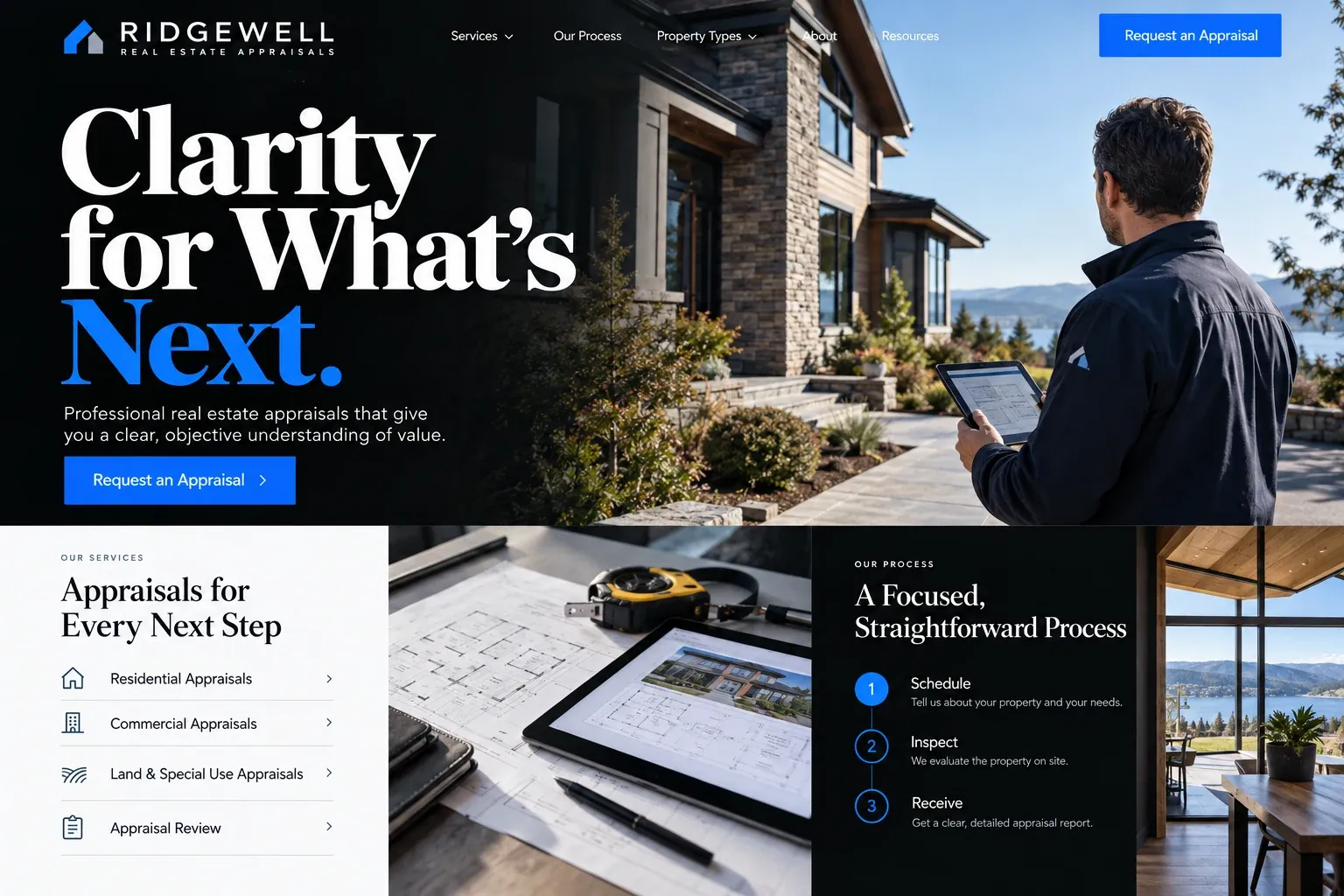
Fictional real estate appraisers website homepage design concept
A design concept for a fictional brand. Your site is designed from scratch around yours.

Your customer's story

Settling her mother's estate, one form at a time

Natalia's mother passed away in the spring, and the family house in Westchester is now part of an estate. The probate attorney tells her she needs an appraisal of the house as of the date of death. Natalia nods on the call, then sits in her car afterward wondering what that means, whether the value is from today or from March, and who even does that.

Her searches turn up appraisal management companies that only work with lenders, and a few local appraisers whose sites are a logo and a fax number. One site has a page called estate and date-of-death appraisals. It explains in plain words what a retrospective value is, which documents help, how the inspection works when the value date has passed, and which counties the practice covers.

She fills in the inquiry form with the address, the date of death, and her attorney's name, and attaches the deed. The appraiser replies with the scope, the fee, and two inspection times. Natalia never has to pretend she knows the vocabulary. An appraiser's website does its job when a nervous first-timer can recognize the assignment they need and request it correctly.

Why it matters

Why real estate appraisers need a website.

Appraisers live with two kinds of work. Lender assignments arrive through management companies and portals, while private clients, attorneys, accountants, and homeowners go looking for someone directly. Those private clients are where a website matters most. They search for the purpose, such as estate, divorce, tax appeal, or pre-listing, and they need reassurance that the appraiser is credentialed, local, and independent. A directory listing gives a name and a number but explains none of it.

We build appraisal sites around assignment types. Each purpose gets a short page that explains what the report is used for, what the client should gather, and how the inspection works, without hinting at any value. Your credentials, the counties and property types you cover, and your approach to independence sit where people can see them. The inquiry form asks for the address, the purpose, the effective date, and the intended user of the report.

What your customers search for

  • real estate appraiser near me
  • estate appraisal Miami
  • date of death appraisal
  • appraisal for divorce
  • property tax appeal appraisal
  • certified appraiser Miami

Your customers

What clients ask before ordering an appraisal

  • Which kind of appraisal do I need?

    Pages for each assignment you accept, such as estate, divorce, property tax appeal, pre-listing, and partnership buyouts, each explaining its purpose in plain words.

  • Do you cover my property?

    The counties you work in and the property types you take on, from condos and single-family homes to small multifamily or vacant land.

  • Are you qualified for this?

    Your state credential, its level, the license number, and any professional designations, shown plainly and linked where the public can verify them.

  • What should I have ready?

    A short checklist for the inspection: access, recent improvements, a survey or floor plan if available, and any documents the purpose calls for.

What we build

What a website for real estate appraisers should include.

  • Assignment type pages

    A page per purpose you accept, written for the person ordering it, never hinting at the value they might hope for.

  • Coverage map

    The counties and property types you appraise, shown on a map and in a list so nobody requests work outside your area.

  • Credentials and background

    License level and number, designations, and the kinds of assignments you have handled, stated accurately in your own words.

  • Appraisal inquiry form

    Address, property type, purpose, effective date, intended user, and contact details, with room to attach a deed or prior survey.

  • Attorney and accountant page

    A page for referring professionals explaining how to engage you for estates, litigation, or tax work, and what reports they receive.

  • Process in plain steps

    Inquiry, scope and fee, inspection, research, and delivery of the report, each step explained so first-time clients know what comes next.

Planning guide

What should an appraiser's website explain to private clients?

Lenders know exactly how to order an appraisal. Families, executors, and small investors usually do not. An appraisal practice's website bridges that gap by naming the assignments it accepts, showing who does the work, and collecting the details needed to define the job. Below is a practical outline for those pages, the inquiry, and local search.

Name the assignments you accept

People search by purpose, not by appraisal theory. Give each type of work its own short page: estate and date-of-death values, divorce, property tax appeals, pre-listing, and anything else you take on, such as small commercial or land. Explain who usually orders it, what the report is used for, and what the client should gather. If a homeowner cannot order a mortgage appraisal from you directly, say so and explain that the lender arranges it.

Show credentials and independence plainly

Clients and attorneys want to know the appraiser is qualified and has no stake in the outcome. Show your credential level and license number, any designations you hold, the years and kinds of work you can document, and a short statement on independence in your own words. A real photo and a short bio help more than a stock image of a clipboard. Leave out any phrasing that suggests a value can be shaped to fit a need.

Collect the details that define the job

An appraisal inquiry is really a scoping conversation. The form should ask for the property address and type, the purpose, the effective date (today or a past date), the intended user, and any deadline set by a court or attorney. Let clients attach a deed, survey, or prior appraisal. With that in hand you can quote and schedule without a long back-and-forth.

Attorneys and accountants often prefer the phone, so give them a direct number and a page explaining how they can refer clients to you. The form needs only what defines the assignment, never bank details or other sensitive financial records. Say how quickly you usually reply to inquiries, in words you can keep to.

Be findable for each purpose and county

Searches for appraisers are specific: estate appraisal Miami, divorce appraiser Broward, appraisal for property tax appeal. Assignment pages and a clear coverage area give search engines those exact topics to match. Keep your name, address, and phone the same on the website and your Google Business Profile, and ask attorneys and private clients who were satisfied to leave a review. No site can promise a ranking, but this gives a credentialed appraiser a fair chance to appear.


In your market

Built for appraisal work in South Florida

Appraising here means condos of every age, from new towers to older buildings facing major structural repairs, plus waterfront homes, flood zones, and hurricane damage that can change a property's condition overnight. Some owners appeal their assessed values, and estates frequently involve heirs who live out of state or abroad. Many clients prefer Spanish. We build pages that explain your assignments clearly to that audience, show the counties you cover, and can add a Spanish version of the site.

Questions

Questions real estate appraisers ask us.

Should our appraisal site mention mortgage appraisals at all?

Briefly, yes, because homeowners often search for one. A short note explains that the lender orders the appraisal for a mortgage, then points to the private assignments you do accept. That saves you calls you cannot take and helps the right clients find the right page.

Can clients upload documents with their appraisal request?

Yes. The inquiry form can accept a deed, a survey, a prior appraisal, or photos, and sends them to your email along with the request. It sticks to what defines the job, so clients are never asked for account numbers or financial statements.

How much should an appraiser's site say about its credentials?

Enough for a careful attorney to check. Show your credential level, license number, and designations, with a link to the state's public license lookup. A short bio describing the property types and assignments you handle regularly is more useful than a long list of everything you have ever appraised.

Should an appraiser's website show client reviews?

Yes, with care. Reviews from clients, attorneys, and accountants can reassure first-time clients, as long as they talk about service, clarity, and timeliness rather than the value reached. We can show reviews from your Google Business Profile and help you ask satisfied clients for them in a way that keeps your independence clear.

Let's talk

Ready for a website built for real estate appraisers?

Tell us about your business and we will come back with a clear recommendation and a fixed quote. No pressure, no jargon.

Trades we design for

See all 226 trades

226 trades

  • Plumbers website design concept
CallFree quote