Web design for trade schools

Websites that show students the work behind the course.

Students who enroll in a trade program are making a practical bet with their time and savings. Before they visit, they want to see what they will learn, when classes meet, and which tools they will use.

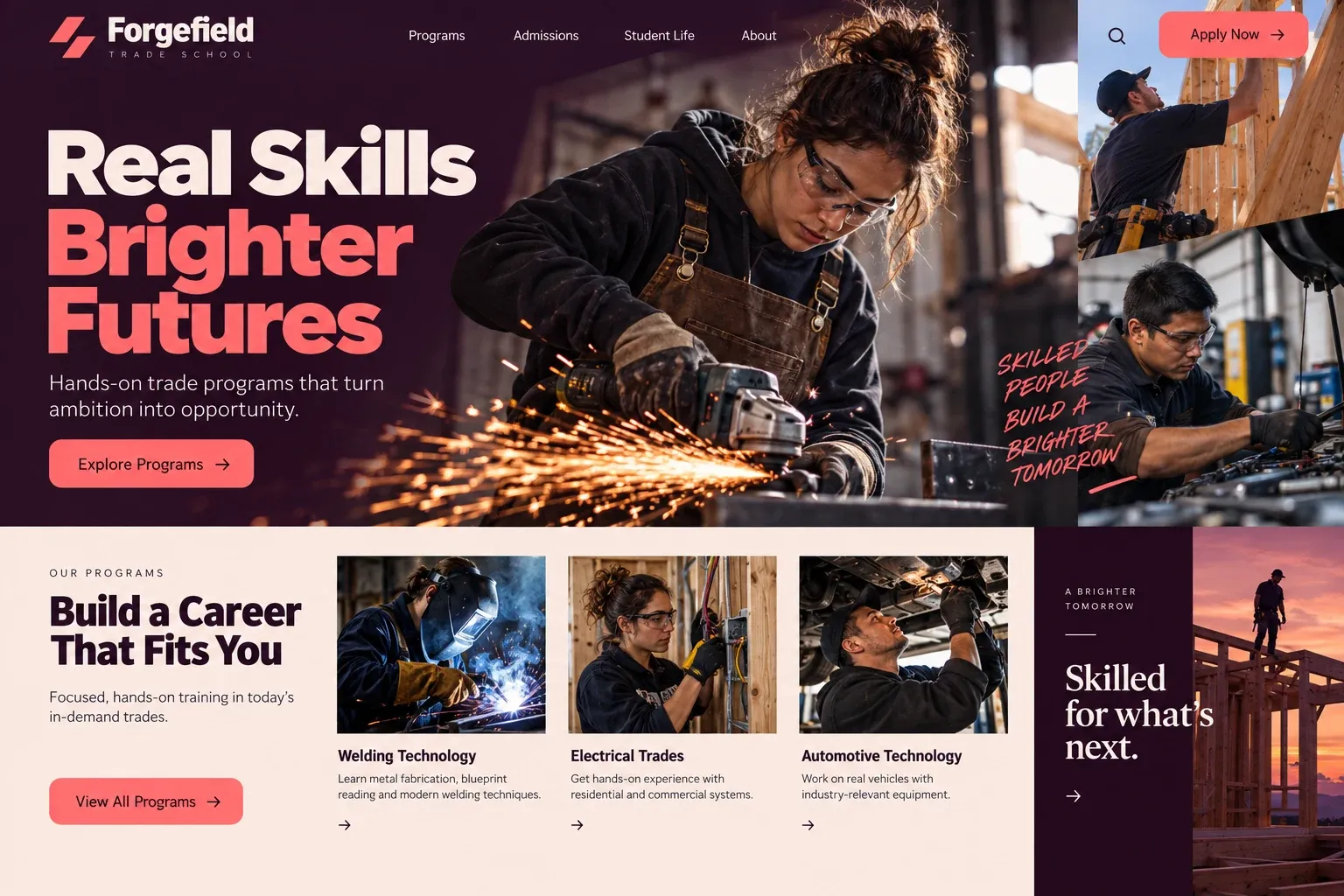
Fictional trade schools website homepage design concept
A design concept for a fictional brand. Your site is designed from scratch around yours.

Your customer's story

Done with night shifts at the warehouse

Kevin has worked night shifts at a distribution warehouse for six years. His back hurts, his schedule leaves no time with his daughter, and his cousin, an electrician, keeps telling him the trade is short of people. After a shift ends at six in the morning, he sits in his car in the parking lot and searches "electrician program evening classes" before he drives home.

The first school's site is all stock photos of smiling graduates and the word career repeated in every heading. Another asks for his phone number before it shows any program details, and he closes it. The third lists its electrical program by module, shows photos of the actual lab with conduit benders and panel boards, gives evening class times, and explains what he needs to enroll.

He requests an admissions call and adds a note: he works nights and can only talk mornings. Nothing on that site promises him a job or a salary, and that makes the rest easier to believe. A trade school website has to show a careful adult exactly what the course covers and how it fits a working life, because that is the decision they are making.

Why it matters

Why trade schools need a website.

Trade school applicants compare programs with real care. Many are adults changing careers, paying their own way, and fitting class around a job. They read program pages line by line, look for the schedule, the hours of hands-on work, and the tools in the shop, then ask friends in the trade. A social media page full of graduation photos cannot answer those questions, and an education directory lists you beside dozens of others.

We build trade school sites around the program page. Each program gets its own page with the curriculum by module, the balance of classroom and shop time, the schedule options, entry requirements, and what students need to bring. Credentials and approvals appear only as you hold them, in your exact wording. Shop photos come from your own lab, and the admissions inquiry asks which program and schedule interest the student.

What your customers search for

  • trade school near me
  • HVAC school Miami
  • welding classes near me
  • electrician training program
  • evening trade school classes
  • trade school in Miami for adults

Your customers

What future students ask a trade school

  • What will I actually learn?

    Curriculum listed module by module, with the hands-on skills practiced in each and the balance of classroom and shop hours.

  • Can I keep my job while I study?

    Day, evening, and weekend schedules laid out plainly, with start dates and how many hours a week each option takes.

  • Do I qualify to enroll?

    Entry requirements written exactly as your admissions team applies them, from diploma or equivalency to any placement test or interview.

  • What happens after I finish?

    An honest page on what the program prepares students for, including any certification exams graduates may take, with no promises of jobs or earnings.

What we build

What a website for trade schools should include.

  • Program pages by trade

    HVAC, electrical, welding, plumbing, or automotive, each with curriculum, schedules, and requirements gathered on one page.

  • Shop and lab gallery

    Photos of your real training spaces, equipment, and students at work, so applicants see the hands-on side.

  • Schedules and start dates

    Day, evening, and weekend cohorts with upcoming start dates, kept current on one page and updated whenever a new class opens.

  • Entry requirements

    Plain statements of what applicants need, from documents to testing, matching what admissions actually asks for.

  • Admissions inquiry

    A form for program of interest, schedule preference, and best time to call, sent straight to your admissions team.

  • Instructor backgrounds

    Short profiles of instructors with their years in the field and the trade work they did before teaching.

Planning guide

How should a trade school present its programs online?

A trade school's website is where applicants decide whether a program is worth a phone call. They want the facts that matter to a working adult: the curriculum, the schedule, the requirements, and the shop. This guide walks through the pages to build, the proof to show, the admissions path, and how the school gets found locally.

Make each program page complete

The program page is where enrollment decisions happen, so it should hold everything in one place: a plain description of the trade, the modules in order, hours in the classroom and in the shop, schedule options, start dates, entry requirements, and what students supply themselves, such as boots or hand tools. Applicants who must click through five pages to piece this together often give up.

Be exact about credentials. Name any approvals or affiliations only as your school holds them, word for word, and describe licensing exams graduates might take without suggesting the course alone qualifies anyone. Leave out job placement figures and salary claims unless you can document them, and even then, let your admissions team decide how they appear.

Show the shop, not the stock photo

Applicants want to picture themselves in your lab. Photograph the welding booths, the training panels, the engine bays, and students working with real equipment, with permission from anyone shown. Short captions that name the equipment help both readers and search engines. A single honest photo of a cluttered, busy shop says more about hands-on training than a polished image of a stranger in a hard hat.

Guide applicants into an admissions conversation

Most people are not ready to apply on their first visit, so give them a gentle next step. An admissions inquiry that asks for the program, the preferred schedule, and the best time to call is enough. Offer campus tours or open house dates on the same page, and explain what the admissions conversation covers, so nobody fears a hard sales pitch.

Many applicants need to talk through schedules with family or an employer before committing. A downloadable program sheet, with modules, hours, and start dates, gives them something to share. Make sure a real person answers the phone number on the page, and say when admissions staff are available, including any evening hours for working applicants.

Help local applicants find each program

Applicants search by trade and city: welding school near me, evening HVAC classes in Miami. A dedicated page per program gives each of those searches a match. Keep your campus address and phone consistent across the site and your Google Business Profile, add directions and parking or transit notes, and ask graduates for honest reviews. Over time, clear program pages give search engines a precise match for each trade you teach.


In your market

Built for trade schools in South Florida

South Florida keeps skilled trades busy year round: air conditioning that never really rests, a steady stream of construction and renovation, marine work along the coast, and storm repairs after hurricane season. Many applicants are bilingual adults, some trained in another country and looking to work here. Classes in Spanish, evening schedules, and transit directions matter to them. We write program pages with those students in mind and can add a Spanish version of the site.

Questions

Questions trade schools ask us.

How much curriculum detail should a trade school program page show?

More than most schools publish. List the modules in order, the hands-on skills in each, and the split between classroom and shop. Applicants comparing programs use that detail to decide, and it also answers questions your admissions staff would otherwise repeat on every call.

Can our trade school site mention accreditation and job placement?

Only what you can document, worded exactly as the granting body or your records state it. We do not write placement rates, salaries, or approvals on your behalf. Your team supplies and approves that wording, and we place it where applicants look for it.

Can applicants start enrolling in our trade programs on the website?

They can send an admissions inquiry or request a tour, which arrives in your inbox. If you use an online application system, the site links to it from each program page. Personal documents and financial details belong in that secure system, never in an ordinary contact form.

We run day and evening classes for each trade. How do we show that clearly?

Each program page gets a schedule section that compares the options side by side: days, hours, length, and the next start date. When a new cohort opens, you send us the dates and we update the page, so applicants never plan around an old schedule.

Let's talk

Ready for a website built for trade schools?

Tell us about your business and we will come back with a clear recommendation and a fixed quote. No pressure, no jargon.

Trades we design for

See all 226 trades

226 trades

  • Plumbers website design concept
CallFree quote