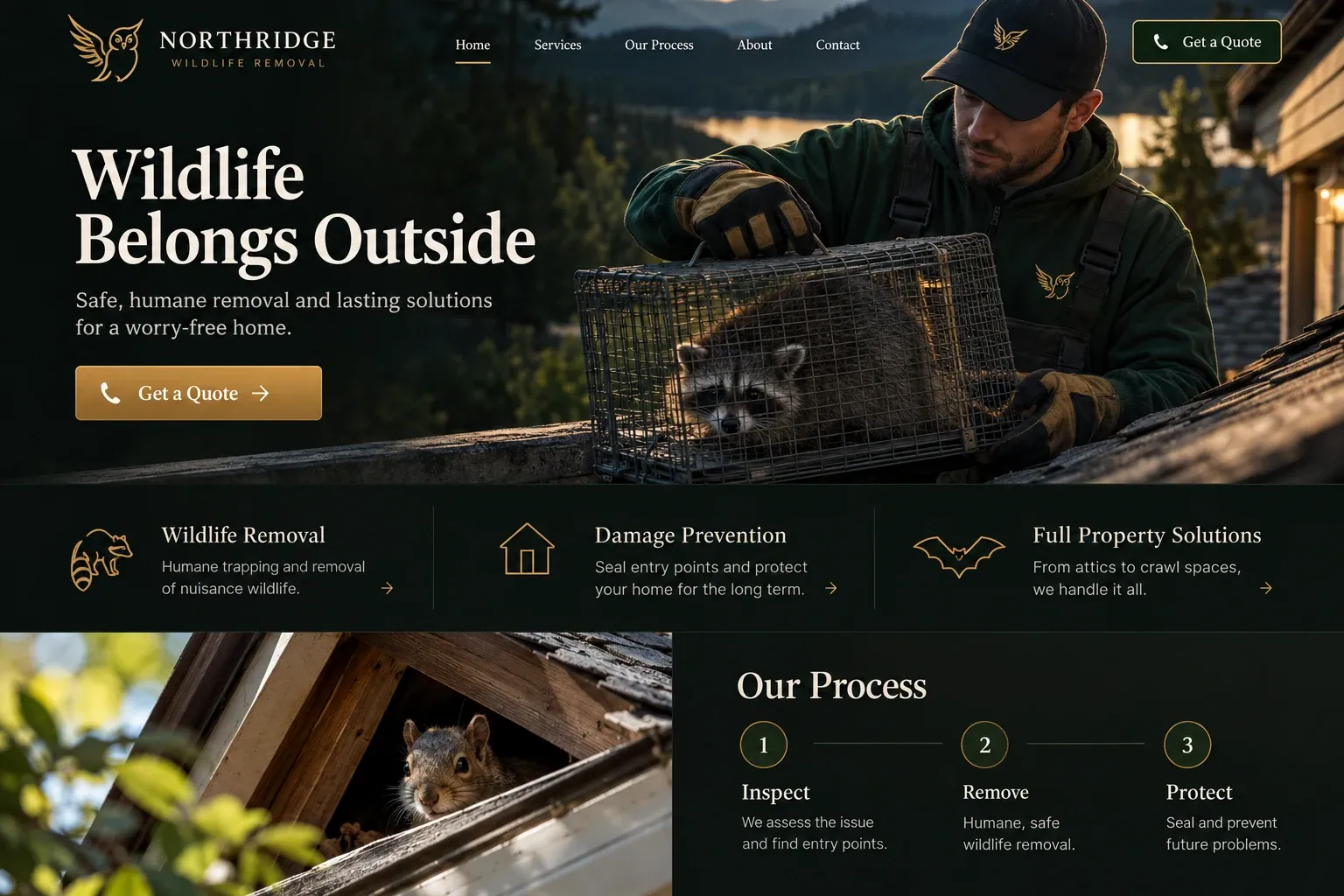
Planning guide
How can a wildlife removal website calm worried homeowners?
A wildlife removal website talks to people who are worried, tired, and unsure what they are dealing with. The best ones settle the visitor down, explain the process, and collect useful details before the visit. Here is how we plan the pages, the proof, the inquiry form, and the local search structure for a wildlife business.
Lead with the inspection, not the animal
Homeowners think the job is catching the animal. You know the job is finding every entry point, removing the animals humanely, sealing the house, and cleaning up. Make the inspection the first step on the site: what you check outside, what you check in the attic, roughly how long it takes, and what the owner receives afterward. That framing sets fair expectations and explains the value of the work that follows.
Give each species its own calm page
People search for the animal they suspect: rats in the attic, a raccoon in the ceiling, iguanas digging under the seawall, bats in the eaves. A page for each animal you handle should describe the signs, explain your general approach, and note any seasonal limits, such as the months when bats are raising their young. Keep the photos clear and accurate, never sensational, and mention the cities you cover.
Mention the wildlife rules that apply to your work in general terms and say that you follow them. Do not give home remedies or trapping tips. A visitor who reads a page and decides to climb into the attic with a broom is a risk to themselves, and the page should gently steer them toward calling a professional instead.
Show the exclusion work that keeps animals out
Exclusion is where much of the value sits, and it photographs well. Show soffit repairs, vent screens, roof return seals, and the gaps under decks closed off with heavy mesh. Describe the materials you use and any workmanship warranty, in your own words. These photos prove the work is real carpentry and sealing, not just a trap left on the roof, and they help justify the estimate.
Make it easy to describe the problem
A good inquiry form asks what the customer hears or sees, when it happens, where in the house, whether there are droppings or damage, and whether pets or children are at risk. Accept photos and short videos. Keep the phone number prominent for animals already inside the living space. Pair that with a Google Business Profile that matches the website, so nearby homeowners find the same details everywhere.