Web design for deck and patio builders

Website design for deck and patio builders.

Most decks and patios begin as a picture of an evening, not a list of measurements. Homeowners want to see that picture built somewhere real before they let anyone measure their yard.

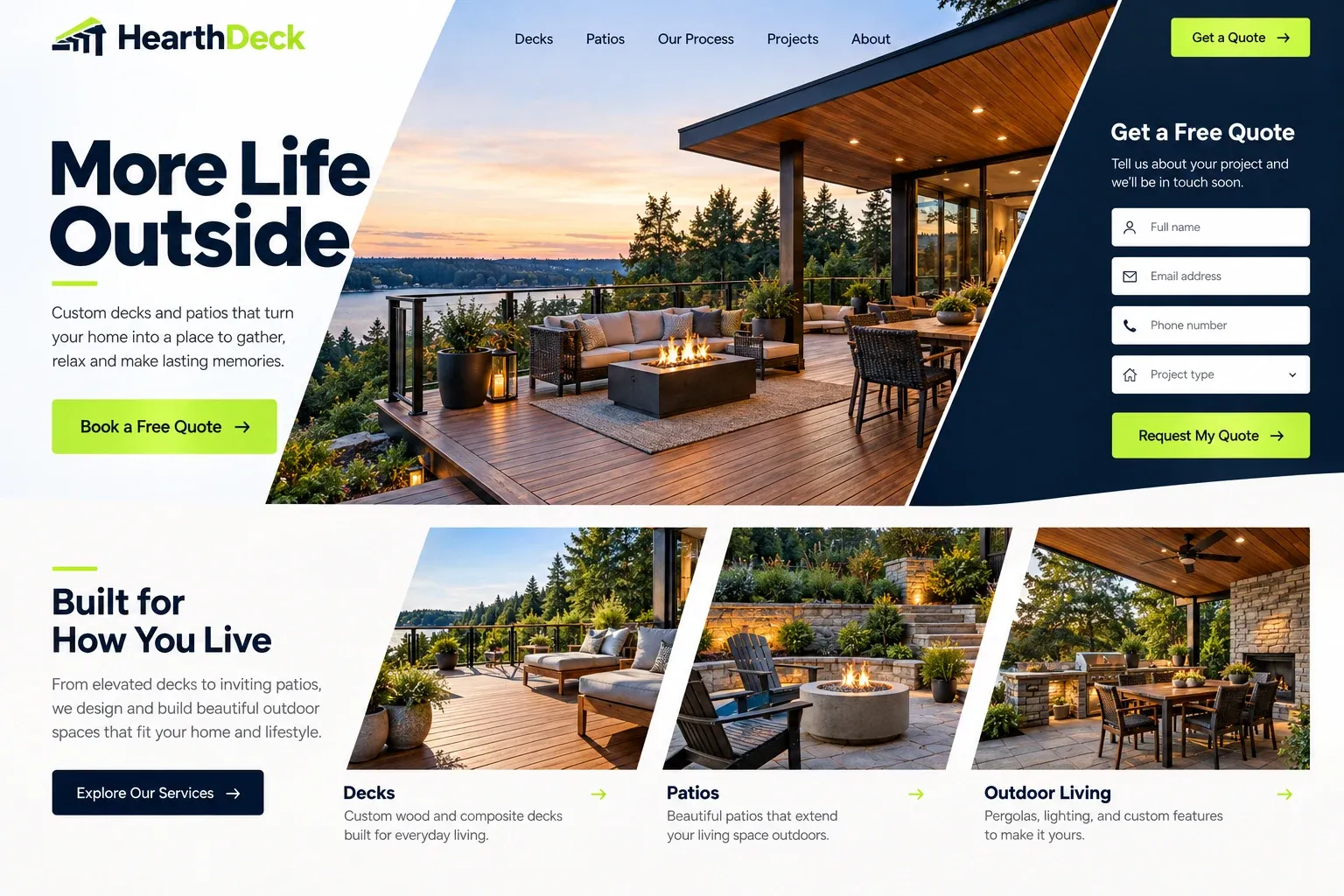
Fictional deck and patio builders website homepage design concept
A design concept for a fictional brand. Your site is designed from scratch around yours.

Your customer's story

Sunday dinner keeps ending up indoors

Every other Sunday, Carla's parents and her brother's family come over, and every other Sunday they end up crowded around the dining table because the yard behind the house is a cracked slab and a strip of patchy grass. After one more dinner where the kids eat standing at the counter, she walks outside with her coffee, looks at the empty space, and starts searching "paver patio with pergola" on her phone.

What she finds is mostly close-ups: a stack of composite boards, a single paver pattern, a railing against a blue sky. None of it shows where the back door is or where the shade falls at five o'clock. Then she lands on a builder whose site shows whole yards before and after, names the materials used, and explains how a covered section was tied into the roofline of a house much like hers.

The form on that site asks how many people she usually hosts, whether she wants shade, cooking space, or both, and which door the patio should open from. She sends a photo of the slab and feels, for the first time, that someone will design around her Sundays. A deck and patio website earns that inquiry by showing finished spaces in use and the thinking behind each one.

Why it matters

Why deck and patio builders need a website.

Outdoor projects are bought with the imagination first and the budget second. Homeowners collect photos for weeks, argue over wood, composite, and pavers, and ask friends who built something similar. A social media feed shows a nice angle of a finished deck, but it cannot explain why one material suits a sunny pool deck and another suits a shaded porch, or walk a family from sketch to permit to first barbecue.

We build deck and patio websites that lead with finished outdoor rooms and follow with the practical detail. Each project shows the whole space in relation to the house, the materials named plainly, and a line about how the family uses it. Material pages compare options honestly, a process page covers design, permits, and construction, and the project form asks about how the space will be used, not only its size.

What your customers search for

  • deck builders near me
  • paver patio contractor Miami
  • composite deck installation
  • pergola and covered patio builder
  • travertine pool deck
  • deck repair and resurfacing

Your customers

What homeowners weigh before building a deck or patio

  • Wood, composite, or pavers?

    A material page that compares look, heat underfoot, upkeep, and lifespan in plain terms, with photos of each option from your own finished projects.

  • Will it suit our house?

    Project photos taken from the back door and from the far end of the yard, so visitors see how each design connects to the home.

  • Who handles the permit and the HOA?

    A process page that says who draws the plans, who applies for permits, and how you help with homeowners association approval where the community requires it.

  • How much shade can we get?

    Pages for pergolas, covered patios, and shade sails, showing how each one changes the space at midday and in the evening.

What we build

What a website for deck and patio builders should include.

  • Outdoor living gallery

    Finished decks and patios shown in use, with furniture, lighting, and planting, and a note on what each family wanted.

  • Material comparison pages

    Composite, pressure-treated wood, hardwoods, pavers, and travertine, each with honest notes on heat, upkeep, and how it ages.

  • Before and after views

    Side-by-side photos of the same yard, taken from the same spot, so the change is easy to read on a phone.

  • Lifestyle project brief

    A form that asks how many guests the family hosts, whether they cook outside, and where the sun hits, plus a photo upload.

  • Pergolas and outdoor kitchens

    Separate pages for the add-ons that turn a platform into a room: shade structures, summer kitchens, fire features, and lighting.

  • Repair and resurfacing

    A page for tired decks and sunken pavers, which brings in work from homeowners who are not ready for a full rebuild.

Planning guide

How should a deck and patio builder plan a website?

A deck or patio is sold on a feeling and built on details. The website has to carry both: it should make a homeowner want to be outside, then show that you think about drainage, materials, and the way the space meets the house. These are the pages, photos, and contact tools we plan for a builder in this trade.

Photograph the space, not just the surface

The strongest deck and patio photos are taken from where people will stand: the back door, the kitchen window, the far corner of the yard. Show the finished space with furniture and lighting, at midday and at dusk if you can. Close-ups of a board or a paver joint are useful on material pages, but the gallery should sell the outdoor room rather than the product.

Explain materials and stages in plain words

Most homeowners arrive unsure whether they want wood, composite, concrete, or pavers. A page for each material, with real photos and honest notes on heat, slip, upkeep, and how it weathers, answers the questions you would otherwise repeat on every site visit. Mention the manufacturer warranties that apply, and say clearly which parts of the work your own warranty covers.

Then lay out the stages: first visit, design and drawings, permits and any HOA approval, demolition or site preparation, construction, and the final walk-through. Note what can stretch a schedule, such as a permit review or a rainy month. Families who can see the whole path tend to ask better questions and feel less anxious about a crew in their yard.

Use the inquiry form to learn the lifestyle

Dimensions matter, but they rarely tell you what to design. Ask how the family wants to use the space: dining, lounging, grilling, a spot for the kids, a view of the pool. Ask about shade, privacy, and which door opens onto the yard, and let them attach photos or a survey. The reply lands in your inbox, and the first site visit starts with real context.

Give local searches something to match

People search for the thing they want and the place they live: a composite deck in one town, a paver patio in another, a pergola builder nearby. Separate pages for decks, patios, shade structures, and repairs, plus a page naming the communities you work in, give Google specific matches. Keep your details identical on the site and your Google Business Profile, and ask happy clients for reviews with photos.

In your market

Built for outdoor living in South Florida

Outdoor space here gets used most of the year, so homeowners care about heat underfoot, shade, and surfaces that handle heavy summer rain without puddling. Pavers and travertine are common around pools, composite boards resist the damp better than many woods, and screen enclosures and covered patios are everywhere. Hurricane season shapes how pergolas and roofs are anchored, and permits and HOA rules vary by city. Many clients are bilingual, so we can add a Spanish version of the site.

Questions

Questions deck and patio builders ask us.

How should we photograph finished decks and patios for the website?

Shoot from where people will stand, such as the back door or a corner of the yard, with furniture in place and at a couple of times of day. A phone is fine if the light is good. Send a before photo too when you have one, and we pair each set with a short project note.

Can a homeowner send us their yard survey or sketch through the site?

Yes. The project form accepts photos and files, so a homeowner can attach a property survey, a sketch on paper, or pictures of the yard from the back door. Everything arrives in your email with their answers about how they plan to use the space.

Do we need separate pages for decks, patios, and pergolas?

It helps. Someone searching for a paver patio and someone searching for a composite deck want different answers, photos, and materials. Separate pages let each one land on the right content and give Google a specific match. Smaller add-ons, such as lighting or railings, can share a page.

Can the site mention the composite decking brands we install?

Yes, as long as you actually install them. Many builders list the composite and decking lines they work with, and some manufacturers offer approved images and installer programs you can mention if you belong to them. We write it accurately and link to warranty details on the maker's site.

Let's talk

Ready for a website built for deck and patio builders?

Tell us about your business and we will come back with a clear recommendation and a fixed quote. No pressure, no jargon.

Trades we design for

See all 226 trades

226 trades

  • Plumbers website design concept
CallFree quote