Web design for paving contractors

Paving websites that start at the curb.

Visitors meet a property at the pavement before they reach the door. Whether it is a paver driveway or a plaza parking lot, owners want a contractor who plans around how the space is actually used, day and night.

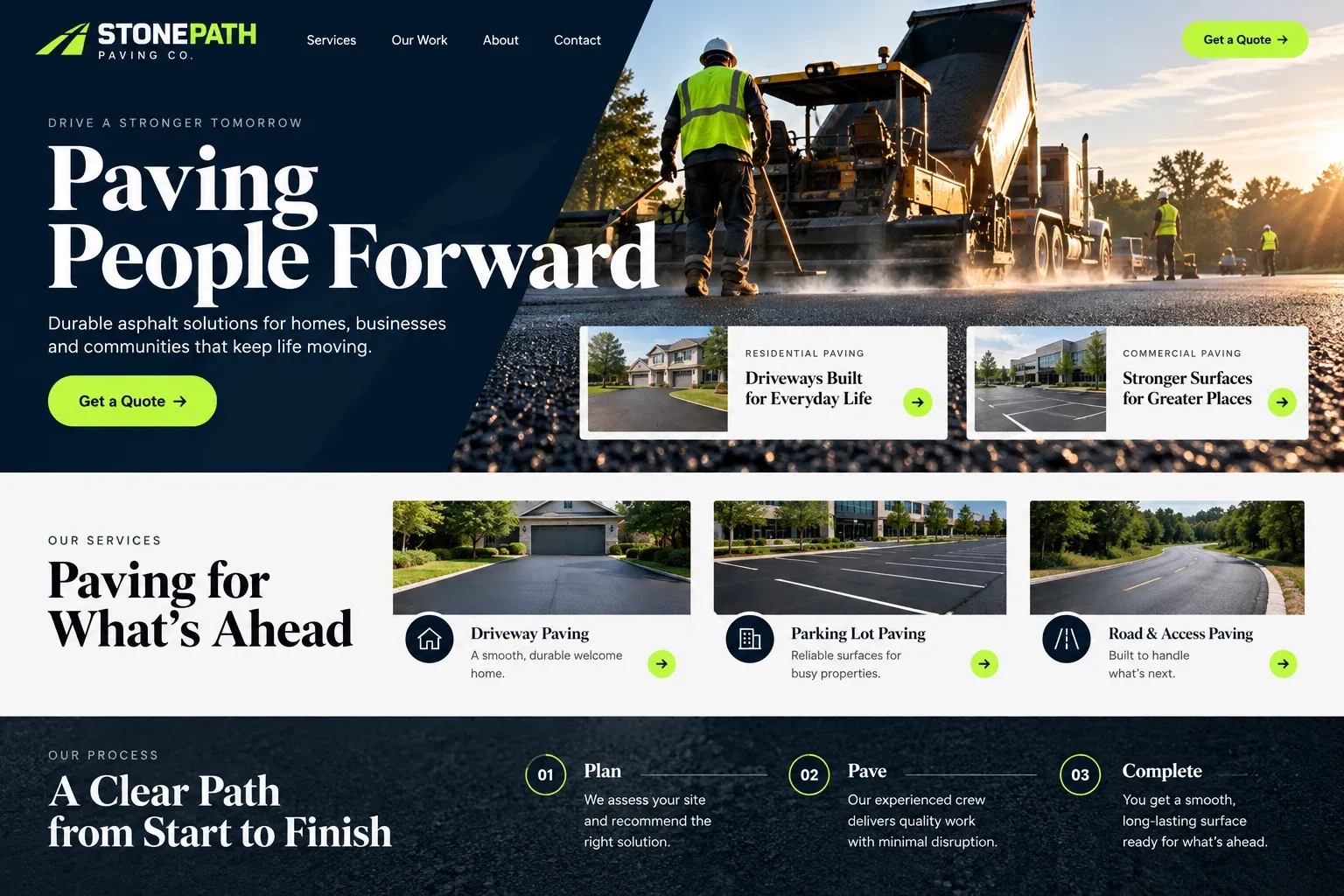
Fictional paving contractors website homepage design concept
A design concept for a fictional brand. Your site is designed from scratch around yours.

Your customer's story

A pothole outside the bakery's front door

The pothole near the entrance of Lucia's bakery started as a crack last spring. Now it holds water after every afternoon storm, and on Saturday a customer steps into it carrying a birthday cake. The rest of the lot is faded and patched, the parking lines are half gone, and delivery vans cut across the corner where the curb has crumbled. Lucia knows it is time.

Her worry is not the paving itself. It is closing. Between the lunch rush and the afternoon baking, she searches for parking lot paving and opens five sites. Three show only paver driveways at private homes. One lists asphalt without a single photo. The fifth has a commercial section with lots like hers, and a page explaining how work can be phased so a business keeps an entrance open.

Its request form asks how many spaces she has, how deliveries reach the back door, which hours are busiest, and whether weekend or night work would help. Lucia fills it in during a quiet ten minutes. A paving contractor's website wins this kind of job by showing it understands that the lot is part of a working business, not just a stretch of asphalt.

Why it matters

Why paving contractors need a website.

Paving customers split cleanly in two. Homeowners want a driveway or patio that looks good and suits the house, and they browse photos for weeks. Property owners and managers want a lot that drains, lasts, and stays usable while the work happens, and they need to know you have done that scale before. A single listing or social page cannot speak to both, and it rarely shows layouts, transitions, or how a job was scheduled.

We build paving websites with separate residential and commercial sections from the first click. Residential pages show paver patterns, borders, and driveway aprons in full view of the house. Commercial pages cover asphalt paving, sealcoating, striping, and repairs, with notes on phasing and after-hours work if you offer it. Each section has its own request form, asking the questions that matter for that kind of job.

What your customers search for

  • paving contractor near me
  • paver driveway installation Miami
  • parking lot paving
  • asphalt sealcoating near me
  • parking lot striping
  • paver repair and resanding

Your customers

What owners need to know before hiring a paving contractor

  • Can my business stay open?

    A page on phasing, keeping entrances usable, and night or weekend scheduling where you offer it, with photos of lots worked in sections.

  • Pavers, asphalt, or concrete?

    A short comparison written from your experience, covering looks, upkeep, repairs, and where each material tends to suit homes or commercial lots.

  • What will the layout look like?

    Project photos taken from above or at an angle, showing patterns, borders, curbs, and where the paving meets the street, lawn, or building.

  • Where will the water go?

    A plain note on how you plan slope, drains, and low spots, since standing water is often the reason the call is made.

What we build

What a website for paving contractors should include.

  • Residential and commercial paths

    Two sections with their own photos, services, and forms, so a homeowner and a plaza manager each land on the right page.

  • Layout and pattern gallery

    Herringbone, running bond, and basket weave pavers, borders, and full parking layouts, photographed so the whole design reads at a glance.

  • Phasing and access notes

    How you keep entrances, deliveries, and customer parking moving during the work, explained in plain terms for business owners.

  • Sealcoating and striping pages

    Maintenance services with their own pages, so property managers searching for resealing or restriping find you directly.

  • Area-use inquiry form

    Asks what the space is used for, rough size, traffic, deliveries, and timing constraints, so your estimate starts with the right facts.

  • Repair and patch requests

    A quick form for potholes, sunken pavers, and cracked aprons, with a photo upload for owners who need a smaller fix.

Planning guide

How should a paving company organize its website?

A paving company often serves two very different buyers, and a website that mixes them tends to lose both. The best paving sites separate homes from commercial properties, show layouts clearly, explain how work is scheduled, and ask the right questions up front. These are the parts to plan and how each one helps the business get found.

Give homes and businesses their own sections

Start with two paths from the home page. The residential side covers paver driveways, patios, pool decks, and walkways, with plenty of photos. The commercial side covers parking lots, asphalt paving, sealcoating, striping, and repairs, with notes on scale and scheduling. Each side gets its own request form. Add an about page with your crew and equipment, a gallery, and a contact page that lists the counties and cities you work in.

Photograph the layout, not just the surface

A close-up of pavers shows quality, but owners also need to see the whole design: how the pattern turns at a corner, where the border runs, how the driveway apron meets the street, how a parking lot flows from entrance to exit. Shoot from a second-story window, a ladder, or a drone where it is allowed. Before photos of potholes, sunken pavers, and faded lines make the result easier to appreciate.

Label each project with the material and pattern, and for commercial work, the type of property and what was done, such as milling and overlay, new striping, or drainage repair. Property managers scan for jobs like theirs. Use only your own photos, and keep descriptions to what your crew actually did.

Explain scheduling and gather the right details

Many commercial customers worry more about closing than about the estimate. A short page on how you phase a lot, keep at least one entrance open, coordinate with deliveries, and handle curing time before traffic returns answers that worry directly. Homeowners have a smaller version of the same question: where do we park while the driveway is done? Say how you handle it. A plain account of how the work unfolds reassures owners far more than a fast start date.

The request form should follow the same thinking. Ask what the space is used for, its rough size or number of spaces, how deliveries and traffic move, any standing water, and the times work cannot happen. Let owners attach photos, and keep a tap-to-call number close for anyone who prefers to talk first.

Show up for searches by property type

Paving searches tend to name the job: "paver driveway installation", "parking lot sealcoating", "asphalt repair near me". A page for each service you want gives Google a clear match, and an areas page shows where you work. Keep your Google Business Profile consistent with the site and add photos of finished jobs there. Reviews from property managers carry weight with other managers, so ask for them. None of this settles where you rank, but it lays the groundwork.

In your market

Built for paving in South Florida

Paving in South Florida means pavers on a huge number of driveways and pool decks, asphalt on plazas and office parks, and summer downpours that find every low spot. Heat softens fresh asphalt and sun fades sealcoat, sand bases shift under pavers when drainage is poor, and many communities need homeowners association approval before a driveway changes. We write pages that address these conditions directly, and a Spanish version suits owners and managers who prefer it.

Questions

Questions paving contractors ask us.

Should a paving company keep residential and commercial work on one website?

One website with two clear sections usually works best. Each section has its own photos, service pages, and request form, so homeowners skip the parking lot specs and property managers find commercial examples fast. Your brand, reviews, and contact details stay in one place, which also helps local search.

How can our paving site show large parking lot projects well?

Wide photos from a height, a before shot of the old surface, and a short note on what was done, such as milling, overlay, drainage fixes, and restriping. If you used phasing to keep a business open, say so. We arrange these as project pages that property managers can scan quickly.

Can customers send paving requests with photos and measurements?

Yes. The form asks what the area is used for, its rough size, and any problems like standing water or sunken pavers, and it accepts photos. Requests arrive in your email. Homeowners and businesses each get a version of the form with questions suited to their job.

Is it worth a separate page for sealcoating and striping?

If you want that recurring work, yes. Property managers search for those services by name, often on a maintenance schedule, and a dedicated page with photos and a simple request form answers them directly. It also gives that steady, smaller work a place to land between larger paving jobs.

Let's talk

Ready for a website built for paving contractors?

Tell us about your business and we will come back with a clear recommendation and a fixed quote. No pressure, no jargon.

Trades we design for

See all 226 trades

226 trades

  • Plumbers website design concept
CallFree quote